Pilates studio management software is your digital right hand, a purpose-built tool designed to automate all the administrative grunt work—from booking classes to processing payments and managing client communication. It's what lets you step away from the front desk and get back on the reformer, focusing on what you love.
Beyond the Reformer: How Software Runs Your Studio
Picture this: no more chasing down late payments. No more frantic text messages trying to untangle scheduling conflicts over the last available reformer. No more manually confirming every single appointment. For too many Pilates studio owners, that administrative chaos is the daily grind, stealing focus from their clients and their passion.
This is exactly where modern software steps in. Don't think of it as just a fancy calendar; think of it as the central nervous system for your entire business. It’s the invisible thread connecting everything—from the moment a new client books their first session on your website to the minute you process payroll for your instructors. It takes all that operational friction and turns it into a smooth, harmonious system.
Your Digital Operations Hub
At its core, this software becomes the single source of truth for your studio. You can finally ditch the clunky spreadsheets, paper sign-in sheets, and separate payment apps. Everything lives in one integrated platform.
This isn’t just about making your life easier; it’s about creating a far better client experience. When a client can book, pay, and manage their membership from their phone, they feel more empowered and more connected to your studio. It’s seamless.
This kind of digital-first approach is quickly becoming the standard, not the exception. The wider wellness software market is booming, projected to grow from around $140.75 billion in 2022 to nearly $409 billion by 2032. As the Pilates Education Institute's industry analysis points out, this surge shows a clear demand for smarter tools that handle everything from mobile booking to personalized client tracking.
More Than Just a Booking Tool
Ultimately, the right platform becomes the backbone of a modern, profitable Pilates studio. It's your silent partner, working 24/7 to make sure your classes are full, payments are collected on time, and clients get the reminders they need.
This operational stability gives you the freedom to focus on what really moves the needle: delivering exceptional Pilates instruction and building a strong, loyal community. By automating the backend, you create more time and energy for the hands-on work that truly defines your brand.
What’s Really Inside Your Digital Studio Toolkit?
When you graduate from a basic digital calendar to true pilates studio management software, you’re not just getting a scheduling tool. You’re installing a complete operational engine for your entire business. These platforms aren't about mere convenience; they're built with specific, powerful features designed to work together and eliminate the daily administrative headaches that pull you away from your clients.
Think of it like a perfectly choreographed Pilates routine. Each feature is a distinct movement, but their real power shines when they flow together, creating a seamless and efficient system. Every component is there to save you time, slash errors, and give both your staff and your clients a far better experience.
This diagram illustrates how core functions like booking, billing, and communication all stem from a central management hub.
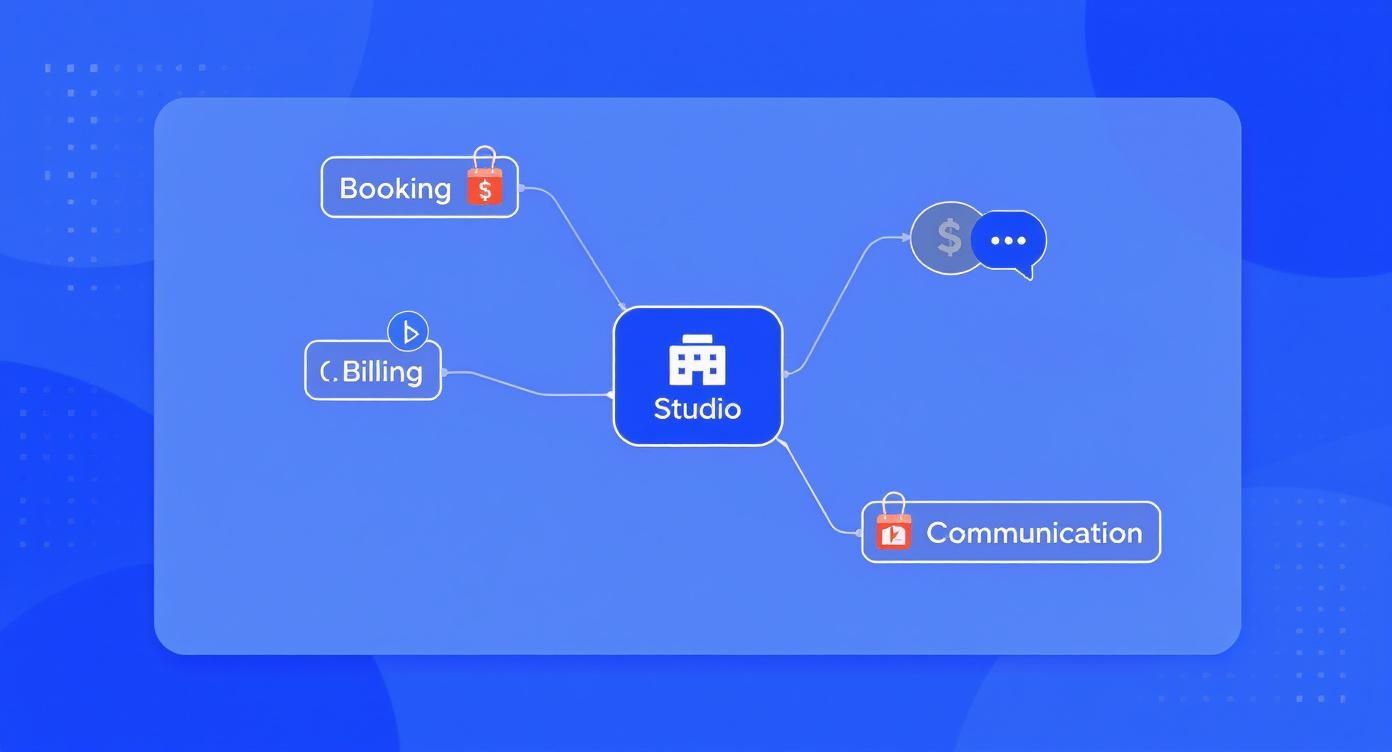
As you can see, a great system isn't a collection of separate tools—it’s an interconnected web that supports every single part of the client journey.
Automated Scheduling and Waitlist Management
Let's be honest: manual scheduling is where operational chaos begins. A forgotten booking, a double-booked Reformer, or a messy waitlist scribbled in a notebook leads directly to frustrated clients and lost income. Modern software makes these risks disappear.
Picture this: your most popular Saturday morning Reformer class is always packed. Instead of manually taking names for a waitlist, the software handles it automatically. The moment a spot opens up, the system instantly pings the first person on the list via text or email. They get a short window to claim it before the offer moves to the next person in line.
This hands-off process not only ensures every last spot is filled but also creates a fair and transparent experience for your clients, building serious loyalty. It transforms a potential frustration (a full class) into a positive, well-managed interaction.
This single feature is a game-changer for maximizing your class capacity and revenue without adding a single minute to your to-do list.
Integrated Payments and Membership Tools
Chasing down late payments is one of the most soul-crushing tasks for any business owner. Integrated payment processing flips this script entirely, turning a manual chore into a quiet, automated process that just works.
The difference is night and day:
- Without Software: You're stuck printing invoices, sending awkward reminder emails, and manually checking who's paid for their 10-class pass.
- With Software: Recurring monthly memberships are charged automatically. Clients can save their payment details securely and buy new class packs with a single tap on their phone.
This system also gives you total flexibility with memberships. If a client needs to pause their account for a month while they travel, you can handle it in seconds. Upgrading someone from a basic to an unlimited membership is just as simple, making it easy for them to commit more deeply to your studio. To see how this all connects, you can check out the full range of pilates studio management software features that power today's studios.
Instructor Scheduling and Payroll Tools
Managing your team is just as crucial as managing your clients. Pilates studio software simplifies this with dedicated portals for your instructors.
They can log in anytime to see their upcoming classes, view the sign-up roster, and update their availability. This self-service approach empowers your team and drastically cuts down on the back-and-forth texts and emails needed to finalize the weekly schedule.
Better yet, many platforms take the pain out of payroll. By automatically tracking how many classes an instructor taught and the attendance for each one, the software can generate dead-accurate payroll reports. This ensures your instructors are paid correctly and on time, every time—a critical factor for keeping team morale high and turnover low.
Automated Client Communication
Great communication keeps your clients engaged and your studio community thriving. Automation is the secret to doing this consistently without spending hours glued to your inbox. The software can send out messages automatically based on specific client actions or timing.
Here are a few essential automations:
- Appointment Reminders: An automated text or email sent 24 hours before a class can slash no-shows by over 25%.
- Welcome Emails: A new client signs up and instantly receives a warm welcome message, letting them know what to expect in their first class.
- Re-engagement Campaigns: If a client hasn't booked a class in 60 days, the system can automatically send them a friendly "we miss you" offer to bring them back.
This steady, personalized communication builds lasting relationships and makes your clients feel seen and valued every step of the way.
To bring it all together, here's a quick look at how these essential features solve real-world studio problems.
Essential Pilates Software Features Checklist
| Feature Category | Key Functionalities | Problem It Solves |
|---|---|---|
| Scheduling | Online class booking, automated waitlists, real-time availability | Eliminates double bookings, reduces administrative time, maximizes class capacity. |
| Payments | Recurring memberships, integrated payment processing, auto-billing | Stops revenue leakage from late payments, automates billing, improves cash flow. |
| Instructor Management | Staff portals, availability tracking, automated payroll reports | Simplifies team scheduling, reduces payroll errors, empowers instructors. |
| Communication | Automated reminders, welcome emails, re-engagement campaigns | Reduces no-shows, builds client relationships, boosts retention effortlessly. |
This checklist highlights the non-negotiable tools that form the backbone of a well-run studio, turning chaotic manual tasks into smooth, automated workflows.
01 / An open slot at 19:00. Players see it live in your club’s app.
Calculating the ROI of Your Studio Software
It's easy to look at pilates studio management software as just another monthly bill. But that's the wrong way to think about it. This isn't an expense; it's a strategic investment in what is essentially your most efficient employee—one that works 24/7 to fill your classes, secure your revenue, and give you a crystal-clear picture of your business's health. The return on that investment goes far beyond just saving a bit of time. It's about building a more profitable, sustainable studio.
Let's get past the feature list and talk about what really matters: the financial results. The magic happens when you translate automated tasks directly into real-world gains. When the software takes over class bookings, waitlist management, and payment processing, you’re not just buying convenience. You're buying back your time.

This shift isn't just happening in a few forward-thinking studios; it's an industry-wide movement. The global market for this type of software was valued at around $500 million in 2025. It's projected to grow at an annual rate of about 15%, potentially hitting $1.8 billion by 2033. That kind of growth sends a clear signal: modern studios understand that smart management tools are no longer a luxury, but a necessity for survival and growth. You can dive deeper into this market growth on MarketReportAnalytics.com.
Quantifying Your Time and Revenue Gains
The most straightforward way to see the ROI is to add up the hours you're getting back. Think about all the little administrative tasks that eat away at your team's week:
- Answering emails and phone calls just to book a class.
- Juggling a messy, manual waitlist.
- Chasing down clients for late membership payments.
- Sending out reminder texts or emails one by one.
- Manually pulling numbers for payroll and attendance reports.
What if software could save your team just 10 hours of that work every week? That’s over 40 hours a month. Suddenly, that time is free to be reinvested in things that actually grow your business—like training your instructors, hosting community workshops, or checking in with clients who haven't been around in a while.
Key Takeaway: Your software’s real return comes from turning saved admin hours into revenue-generating activities. It frees you and your team to focus on the client experience, which is the only thing that truly drives growth.
And it's not just about time. Automated systems plug the leaks in your revenue. A smart waitlist ensures every spot in a popular class gets filled, and automatic billing practically eliminates the awkward "your payment is late" conversation, making your monthly cash flow far more predictable.
Making Smarter Decisions with Data
Beyond the immediate time savings, the real long-term power of good software is the data it hands you. Instead of guessing, you get a clear, at-a-glance dashboard showing you exactly what’s happening in your studio.
This data-driven approach lets you finally answer the big questions:
- What are my most popular classes? Stop guessing and start optimizing your schedule based on what clients actually book.
- Who are my most loyal clients? Identify your VIPs and create special offers or programs to show them some love.
- Where are clients dropping off? Spot attendance dips before they become cancellations and trigger automated emails to bring them back.
By looking at these reports, you can make informed decisions that directly boost your bottom line. If you see your evening mat classes are always half-empty while morning reformer classes have a constant waitlist, you have the proof you need to adjust the schedule and put your resources where they’ll make the most impact.
If you're curious about what this could mean for your studio, play around with this handy revenue calculator for fitness studios to project your potential growth.
This is how your software goes from being a simple booking tool to a strategic partner. It gives you the insights to refine your offerings, keep clients coming back, and build a resilient business that’s ready for anything.
A Practical Checklist for Choosing Your Software
Let's be honest: picking the right management software for your pilates studio feels like a massive decision. It is. This platform will quickly become the central nervous system of your entire operation, touching everything from how your clients feel about booking to how healthy your bottom line is. You want to avoid that sinking feeling of buyer's remorse, so you need a smart way to vet your options and make sure the software truly fits your studio's unique vibe.
Think of it like auditioning a new instructor. You wouldn't hire someone on the spot. You'd want to see them teach, get a feel for their communication style, and make sure they click with your studio’s culture. You need to put potential software through the same kind of real-world test to see if it can handle the pressure. This checklist is your game plan for asking the right questions and making a confident choice.
Evaluate Scalability and Future Growth
The software that feels perfect for your cozy, single-reformer studio today might completely hold you back when you’re ready to open a second location or add a dozen new classes. Scalability isn't just a buzzword; it’s about choosing a partner that can grow with you.
When you're sitting in a demo, get direct with your questions about growth:
- Location Management: How does the platform handle multiple studios? Can I see reports for each location individually and rolled up into one big picture?
- Staff and Client Limits: Do your pricing tiers change based on the number of instructors or active clients? I need to understand exactly how my costs will increase as my community gets bigger.
- Feature Expansion: Can I start with a basic plan and easily add more powerful features later, like a branded app or advanced marketing tools, without a painful migration process?
A scalable solution saves you the monumental headache of having to switch systems right when your business is hitting its stride. You need a platform that celebrates your growth, not one that penalizes you for it.
Prioritize Ease of Use for Everyone
The most powerful, feature-packed software on the market is totally useless if your team finds it clunky and your clients get frustrated just trying to book a class. A clean, intuitive interface isn't a "nice-to-have"—it's a deal-breaker. Your clients are often booking on their phones while running errands; the entire process has to be seamless.
Here's my benchmark for a great user experience: a brand-new client should be able to find a class, create an account, buy a pass, and book their spot in under two minutes, with zero help.
During your trial, test the software from three different viewpoints: the owner, the instructor, and the client. Can your instructors easily pull up their schedules and see who’s coming to class? Can you pull a quick revenue report without getting lost in menus? A platform that feels simple and logical to everyone involved is a clear winner. For more ideas on how to weigh different options, looking at a comprehensive software comparison guide can provide a useful framework, even if it's for a different field.
Scrutinize Integrations and Connectivity
Your studio software doesn’t exist in a bubble. To run a truly efficient business, it needs to talk to the other tools you rely on every day, creating a single, connected digital ecosystem.
Here are the key integrations you should be looking for:
- Website Integration: The booking widget has to embed flawlessly into your website, matching your brand and giving clients a smooth journey from browsing to booking.
- Payment Gateways: Make sure it supports trusted, reliable payment processors that have transparent, easy-to-understand fees.
- Accounting Software: A direct link to tools like QuickBooks or Xero can save you or your bookkeeper hours of tedious, manual data entry every single month.
- Email Marketing Platforms: Connecting to a system like Mailchimp or Constant Contact unlocks the ability to send powerful, segmented marketing campaigns that actually get results.
These connections are what turn your software from a simple scheduler into a powerful automation engine.
Assess Customer Support and Training
Sooner or later, something will go wrong. A payment will fail, or a class will mysteriously vanish from the schedule. When that happens, you need to know that you can get a real, knowledgeable human to help you—fast. Never underestimate the value of great customer support.
Before you sign anything, find out:
- What are their support hours? Are they actually available when your studio is busiest?
- What channels do they offer? Can you call, email, or use a live chat?
- Is there a good library of tutorials or a knowledge base you can use to train new staff members?
Strong support is your safety net. It’s the difference between a minor hiccup that’s fixed in five minutes and a major crisis that disrupts your whole day. Making a thoughtful decision on your software is a key step, much like choosing the right yoga studio scheduling software, where the right features can define your success.
Managing a Smooth Software Implementation
Let's be honest: switching the core system that runs your studio feels like a massive, high-stakes project. But a well-planned transition is less about technical wizardry and more about following a clear, step-by-step process. If you break down the implementation into manageable phases, you can guarantee a seamless switch that barely causes a ripple for your team and actually delights your clients.
Think of it like choreographing a new routine for a class. You start with the foundational movements and build from there, making sure every step flows logically into the next. The goal here is to move from your old system to your new pilates studio management software with precision and confidence—no awkward stumbles allowed.

This kind of careful planning is what prevents the chaos of a disorganized rollout. It sets you up for a successful launch from day one.
Preparing Your Studio Data
First things first: you have to get your existing data organized for the move. This is the bedrock of the entire process. The good news is that most modern platforms, including Book & Go, are built to import your key information, saving you hundreds of hours of mind-numbing manual entry.
Before any import can happen, you need clean, organized data exported from whatever system you're using now. This usually comes down to a few key spreadsheets:
- Client List: Make sure you have their full names, email addresses, phone numbers, and any important notes you’ve kept.
- Active Memberships: This list should detail who is on which plan, along with their renewal dates and current payment status.
- Class Packs: You'll need a list of clients who still have classes left on their passes and exactly how many credits they have.
Nailing this data export is non-negotiable. A clean import means every client's account, membership, and payment history will be spot-on the second you go live.
Configuring Your New System
With your data prepped and ready, it's time to actually build out your new studio environment. This is the fun part, where you get to customize the software to match how you run things. You’ll be setting up your class schedule, creating instructor profiles, and defining your pricing structures exactly the way you want them.
The configuration stage is your chance to refine your offerings. It’s the perfect opportunity to simplify your pricing, archive old class types, or update instructor bios. Don't just copy your old setup—improve it.
You'll also need to connect your payment processor and set up all the automated communications, like booking confirmations and waitlist notifications. Getting this right ensures all those little automated workflows that save you time are ready to fire on launch day, preventing operational headaches down the line.
Training Your Team and Informing Clients
A smooth rollout hinges on your team's confidence. You absolutely have to schedule dedicated training sessions to walk your instructors through the new system. They need to feel completely comfortable managing their schedules, checking class rosters, and handling basic client questions about the new booking process.
At the same time, you need to start letting your clients know about the upcoming change. The key is to frame it as an exciting upgrade that will make their lives easier.
Here’s a simple communication plan you can follow:
- Announce the Change: Two weeks before launch, send out an email highlighting the benefits they'll love, like easier mobile booking or better waitlist management.
- Send a Reminder: A few days before the switch, send another email with the official launch date and simple instructions on how to access their new account.
- Provide Support: On launch day, be ready to help clients with any questions. A short video tutorial or an FAQ page can work wonders here.
This kind of proactive communication gets everyone on board and excited, turning what could be a stressful transition into a celebrated studio upgrade.
Using Your Software to Drive Studio Growth
Once you’ve got your Pilates studio management software handling the day-to-day admin, you can start unlocking its real power. It stops being just a tool for booking and billing and becomes the engine for growing your business. This is the big shift from simply using the platform to actively wielding it to build a more profitable, resilient studio.
The secret is hidden in the data your system collects every single day. Every class booking, every membership sale, and every client check-in is a breadcrumb. Put them all together, and they paint a crystal-clear picture of your studio's health, pointing you toward opportunities you’d probably miss otherwise.
And in a market this hot, you need that edge. The global yoga and Pilates studio market was valued at over $175 billion in 2025 and is expected to grow at a rate of over 12.2% through 2035. That growth isn't just happening on its own; it's fueled by smart studios using technology to keep clients engaged and revenue flowing.
Uncover Insights with Analytics
Think of your software’s reporting dashboard as your new best friend. Instead of going with your gut, you can now use hard data to make smarter decisions that directly fatten your bottom line.
Start by digging into the numbers to answer a few key questions:
- Who are your star instructors? See which teachers consistently pull in the biggest classes and keep clients coming back.
- What are your primetime slots? Pinpoint the exact hours when your classes are always full, maybe even with a waitlist.
- Which pricing options are selling best? Figure out if your clients gravitate toward unlimited memberships, 10-class packs, or simple drop-in rates.
With these insights, you can start making real, revenue-boosting changes. Maybe you add another class with your most popular instructor during a peak time. Or maybe you create a special workshop based on a class that always fills up first. The data tells you what to do next.
Automate Your Marketing Efforts
Beyond just crunching numbers, your software can be a serious marketing machine. You can set up automated campaigns that run in the background, nurturing client relationships and driving repeat business without you lifting a finger. These campaigns use client behavior to trigger perfectly timed, personalized messages.
Think of it as a friendly, digital tap on the shoulder. It’s your system noticing a client hasn’t visited in a while and automatically sending a "we miss you" offer to bring them back into the fold.
This is where things get really clever. You can slice and dice your client list to send super-targeted promotions. For instance, you could promote a new advanced reformer workshop only to clients who've attended more than 20 classes.
To get the most out of this, it helps to understand a few core marketing automation strategies. Making this shift from manual emails to smart, strategic automation is how you truly scale your growth.
Of course. Here is the rewritten section, crafted to sound like an experienced human expert.
Your Top Questions About Pilates Software, Answered
Alright, let's talk about the big questions that pop up whenever a studio owner starts thinking about new management software. Cost, complexity, the fear of switching... these are the real-world concerns that can stop you in your tracks. Let's clear the air so you can make a decision that feels right for your studio's future.
How Much Does This Software Typically Cost?
This is the big one, isn't it? The honest answer is: it varies. The price tag for pilates studio management software depends a lot on the features you need, how many clients you have, and the size of your team. You'll usually run into a few common pricing setups.
- Flat Monthly Fees: Predictable and simple. These can run anywhere from $50 to over $300 a month.
- Per-Member Fees: Some platforms charge you a small amount for every active member in your system. This can be great when you're small but watch out as you grow.
- Transaction Fees: Others might take a small slice of every payment that runs through their system.
My advice? Look past the shiny sticker price. You have to ask about the total cost of ownership. What about setup fees? What are the actual payment processing rates? Does that branded mobile app or the cool marketing tools cost extra? Get the full picture before you commit.
Is Switching From My Current System a Nightmare?
I get it. The thought of moving everything over sounds like a massive headache. But trust me, it’s far less scary than most studio owners think. Modern software companies have gotten really good at migrating data smoothly. Any provider worth their salt will have a dedicated support team to walk you through it.
The real secret is preparation. If you can pull a clean export of your client list, current memberships, and any outstanding class packs, you’ve already done the hardest part. Pro tip: plan the final switch for a slow week, maybe around a holiday. It’ll make the whole thing feel like a calm, organized project instead of a frantic scramble.
With the right partner, this is just a well-managed transition, not a crisis.
Can This Software Handle Both In-Studio and Online Classes?
Absolutely. In fact, if a platform can't do this well, you should walk away. Managing a hybrid schedule is no longer a "nice-to-have"; it's essential for a modern studio.
The best systems are built from the ground up to handle a mix of in-person and virtual classes from one single, clean interface. This means you can manage your in-studio reformer bookings right alongside your livestream classes. Most will even connect directly with streaming platforms to automate sending out links, making it a seamless experience for your clients, whether they're on a mat at home or on a machine in your studio.
Ready to see how an all-in-one platform can pull all of this together for your studio? Book & Go offers a seamless, white-label solution designed to make your brand shine and your day-to-day management a breeze. Explore our features and see what's possible.