So, what exactly is a tennis court reservation system? At its core, it’s specialized software designed to bring a tennis club's bookings, payments, and member management into the modern era. It’s the tool that finally lets you ditch the clunky paper schedules and endless back-and-forth phone calls for a clean, centralized digital hub where members can book courts online, anytime.
How a Reservation System Transforms Your Tennis Club
Picture your club running like a well-oiled machine. Court bookings are seamless, administrative busywork melts away, and your members have never been more engaged. That’s the practical reality a modern reservation system delivers. This isn't just about a digital calendar; it’s about installing a central nervous system for your entire operation.
Think of it like this: it's the difference between using a manual cash register and upgrading to a complete point-of-sale (POS) system. The old way just handled a single transaction. The new way manages inventory, tracks customer data, and gives you powerful insights to grow your business. This kind of tech is no longer a "nice-to-have"—it's become essential for any club serious about growth.
Centralizing Your Club Operations
The real magic of this software is bringing every moving part of your club under one digital roof. This immediately solves the most common headaches that plague clubs still stuck in manual mode, like frustrating double bookings, awkward billing errors, and spotty communication.
- Effortless Bookings: Your members can see real-time court availability and book a slot from their phone in seconds. No more phone tag.
- Simplified Payments: With integrated payment processing, you can stop chasing members for dues or clinic fees. It’s all handled securely online, right at the time of booking.
- Smarter Communication: You can send out automated booking reminders, announce an upcoming tournament, or send targeted messages to keep your community in the loop.
This isn’t just a local trend. The shift is global. In North America, for instance, over 65% of tennis clubs now use a digital reservation platform. That’s a huge jump from just 35% a few years ago, showing just how critical this technology has become. You can learn more about the rise of court reservation software from BookandGo.
Below is a perfect example of how a modern system clearly shows court availability to your members.

This kind of clean, visual layout lets a player find and book an open court instantly, without ever needing to call your staff. It's a win-win: your members are happier, and your team is freed up to focus on more important things.
To really see the difference, let's break down the old way versus the new way.
Manual vs. Automated System: A Quick Comparison
This table lays out the day-to-day operational differences between sticking with old-school methods and adopting a modern reservation system.
| Feature | Manual System (Phone/Paper) | Automated Reservation System |
|---|---|---|
| Court Booking | Staff-dependent, limited to business hours, prone to human error. | 24/7 self-service for members, real-time availability, no double bookings. |
| Payments | Manual invoicing, cash/check collection, chasing late payments. | Secure online payments at booking, automated invoicing, and recurring billing. |
| Member Communication | Phone calls, emails, and bulletin boards. Often inconsistent. | Automated reminders, targeted announcements, and a central communication hub. |
| Reporting & Analytics | Manual tracking in spreadsheets, limited insights into court usage. | Real-time dashboards on revenue, utilization, and member activity. |
| Staff Time | Heavily invested in administrative tasks like booking and payment collection. | Freed up to focus on member engagement, events, and club growth. |
The contrast is pretty stark. One path keeps your team bogged down in repetitive tasks, while the other empowers them—and your members—with technology that makes everyone's lives easier.
The Core Features Every Modern Club Needs

Let's be honest, not all software is built the same. A basic system might let a member book a court, and that’s about it. But a true club management platform? That’s different. It becomes the operational heart of your entire facility. Think of it as the difference between a simple digital calendar and a full-on command center designed to make your club run smoother, bring in more money, and keep your members happy.
This kind of tech is a major reason why the global tennis club market, currently valued around USD 1.58 billion, is set for major growth. The clubs that are thriving are the ones embracing this kind of software. You can dig into more of the numbers on the tennis club market's expansion at Business Research Insights.
So, what are the must-have features?
Real-Time Booking and Scheduling
This is the absolute foundation. A flawless, real-time booking calendar is non-negotiable. It’s the feature that finally puts an end to double-booking nightmares and frees up your staff from having to manually confirm every single reservation.
When a member books Court 3 for 10 AM, it needs to instantly show as unavailable to everyone else, on every device. No exceptions. A great system also lets you get clever with it, setting up specific booking windows for different membership levels or even adding dynamic pricing for those prime-time slots.
Integrated and Secure Payments
Chasing down members for court fees, league dues, or private lessons is a massive time sink. A modern system builds secure payment processing right into the booking process. When someone reserves a court or signs up for a clinic, they can pay with a credit card right then and there.
This simple step does a few amazing things for your club:
- Guaranteed Revenue: You get paid upfront, which massively cuts down on no-shows and unpaid invoices.
- Better Cash Flow: Money comes in predictably, making it much easier to manage your finances.
- Happy Members: It’s a smooth, professional experience for your members—no more awkward conversations about late payments.
Member and Coach Management
The best systems go way beyond just bookings. They act as a lightweight Customer Relationship Management (CRM) tool for your club. Every member gets a profile that tracks their booking history, payment status, and what programs they’ve joined. Suddenly, you have a complete picture of each member, which is gold for sending out personalized messages or targeted promotions.
This isn't just for members, either. It’s a game-changer for your staff. Coaches can manage their own availability in real-time, letting members book private lessons directly with their favorite pro. No more endless back-and-forth emails trying to find a time that works.
Engagement and Competition Tools
A great platform is built to create a buzzing, active community at your club. It should have features designed to get people involved beyond just booking a court for a casual hit. For a closer look, check out our guide on smart booking systems and the features that matter most.
These are the tools that keep members coming back:
- Tournament Management: Run club tournaments with automated draws, schedules, and live results tracking. It takes all the administrative pain away.
- Leagues and Ladders: Easily set up and manage competitive leagues or a club-wide ladder to spark some friendly competition.
- Event Calendars: Promote social mixers, clinics, and other events with easy online sign-ups and payment.
When you bring all these pieces together, your reservation system stops being a simple tool and becomes your club's most valuable asset for growth.
01 / An open slot at 19:00. Players see it live in your club’s app.
Driving Revenue and Member Satisfaction
https://www.youtube.com/embed/GBUqtvW5TqU
So, beyond the cool features, what’s the real-world impact of a tennis court reservation system? When you get down to it, this kind of technology directly fuels three core areas of your club: it drives more revenue, smooths out daily operations, and seriously upgrades the member experience. This isn't just about adding a layer of convenience; it’s about building a more profitable and vibrant club environment.
From a purely financial standpoint, the results are pretty immediate. A smart system makes it dead simple for members to see open slots and book them on the spot, maximizing your court utilization. Every empty court is lost income, and this simple change plugs that leak.
On top of that, automated reminders slash those frustrating no-shows, and smart waitlists mean that a last-minute cancellation is instantly offered to the next person in line. Your revenue stream is protected, automatically.
Boosting Your Bottom Line
A modern booking platform isn’t just about filling courts more efficiently—it opens up entirely new ways to generate income that are next to impossible with a pen-and-paper system.
You can finally introduce dynamic pricing, charging a premium for those high-demand weekend mornings or after-work slots. It’s a smart way to get the most value out of your prime-time inventory. If you're curious about how to get started, we break it down in our dynamic pricing strategies for sports courts in our detailed guide.
This isn't just theory. The data shows that public tennis facilities using digital reservation systems see a staggering 35% higher usage rate compared to those still relying on manual booking. It's a huge difference.
Elevating the Member Experience
Let's be honest, a seamless digital experience is no longer a "nice-to-have"—it's an expectation. Your members want to manage their club life from their phones, whenever it suits them. Giving them 24/7 self-service booking eliminates the old friction and puts them in control, which is a massive win for satisfaction and retention.
A great member experience is the foundation of a thriving club. When booking is easy, communication is clear, and members feel connected, they are more likely to participate in events, sign up for lessons, and become long-term advocates for your facility.
This also has a huge knock-on effect for your staff. Instead of being chained to a phone answering the same booking questions all day, your team can focus on what really matters: engaging with members face-to-face, planning exciting events, and improving the on-site vibe.
To take it a step further, many forward-thinking clubs are integrating tools like the leading chatbots for customer service to handle common questions instantly. When you combine streamlined operations with a superior member service, you create a powerful flywheel that drives sustainable growth.
How to Choose the Right Reservation System
Picking a tennis court reservation system isn't like buying a new ball machine; it's more like bringing on a new business partner. This software becomes the central nervous system of your club, touching every part of your daily operations and, most importantly, your member's experience. Getting this decision right is absolutely critical for your club’s future.
Forget the flashy marketing for a moment. The first thing to do is dig into the fundamentals that make a club run smoothly. A clunky system that fights with your other tools or looks like it's from 2005 can cause more headaches than it solves. You’re not just looking for a calendar—you’re choosing the operational backbone for your entire facility.
Evaluate Core Technical Capabilities
Your reservation system has to play nice with the other technology you already depend on. The last thing anyone wants is a platform that walls itself off, forcing you to manually juggle data between your booking software, website, and accounting tools.
Start your evaluation by asking these critical technical questions:
- Seamless Integration: How easily does this connect to our existing website? Can it sync with our accounting software, like QuickBooks, to make month-end less of a nightmare?
- White-Label Branding: You've worked hard to build your club's brand. Look for providers that offer white-label options, which let you stamp the booking platform with your own logo and colors. This creates a polished, professional look that members trust.
- Mobile User Experience (UX): Let's be real—your members are booking courts on their phones while running errands or sitting on the couch. A flawless mobile app isn't a "nice-to-have," it's a must. Grab your phone, run through the demo, and ask yourself: is this dead simple for someone who isn't tech-savvy?
The goal is to find a system that feels like a natural extension of your club. A disjointed or poorly designed mobile app can frustrate members and lead to low adoption rates, defeating the purpose of your investment.
When you're sizing up potential systems, it helps to understand what's out there in the broader market. A bit of research into comparing online ticketing and booking platforms can give you a solid baseline for what to expect in terms of features, payment processing, and user-friendliness.
Essential Software Evaluation Checklist
Use this checklist to systematically compare different tennis court reservation systems. It helps ensure you cover all the critical features and capabilities during your vendor demonstrations and discussions.
| Evaluation Criteria | Importance (High/Med/Low) | Questions to Ask Vendors |
|---|---|---|
| Website & Accounting Integration | High | "Does your system integrate with our specific website platform (e.g., WordPress, Squarespace) and QuickBooks?" |
| White-Label Branding | High | "Can we fully customize the app and booking portal with our club's logo, colors, and branding?" |
| Mobile App & User Experience | High | "Can we test a live demo of the member-facing mobile app? Is it native for both iOS and Android?" |
| Data Security & PCI Compliance | High | "Are you fully PCI compliant? What specific measures do you take to protect member payment information?" |
| Customer Support Availability | High | "What are your support hours? What is your guaranteed response time for a critical issue on a weekend?" |
| Reporting & Analytics Suite | Medium | "Can you show me a demo of the analytics dashboard? What key reports are available for court utilization and revenue?" |
| Coach & Lesson Scheduling | Medium | "How does the system handle split payments for group lessons and manage coach availability?" |
| Tournament & League Management | Low | "Does the platform include features for running tournaments, creating brackets, and managing league standings?" |
| CRM & Member Communication | Medium | "Can we send targeted emails or push notifications to specific member groups directly from the system?" |
This checklist isn't exhaustive, but it provides a strong framework to guide your decision-making process. By focusing on these core areas, you can cut through the sales pitches and identify a true technology partner for your club.
Prioritize Security and Support
Beyond the bells and whistles, you need a partner you can trust—with your data, with your members' payment info, and with your club's reputation. This is one area where you absolutely cannot cut corners. A data breach or an unresponsive support team can undo years of hard work.
- Data Security and PCI Compliance: The platform must be PCI compliant to handle credit card payments safely. Don't be shy about asking potential vendors tough questions about their data encryption and security protocols.
- Responsive Customer Support: What happens when the system goes down on a busy Saturday morning? You need to know that a real, knowledgeable human is there to help. Check online reviews and ask directly about their average support response times.
- Reporting and Analytics: The best reservation systems don't just take bookings; they give you actionable insights. Make sure the software has robust reporting tools that let you easily track court utilization, revenue per court, and member activity trends. This data is gold for making smarter business decisions.
A Step-by-Step Implementation Guide
Making the switch to a new tennis court reservation system can feel like a massive undertaking, but it doesn't have to be. With a bit of planning, you can roll out your new software smoothly, getting your members and staff excited from day one. The secret is breaking the process down into clear, manageable steps.
The journey starts long before you even touch the software. It begins with your data. You’ll need to pull together accurate member lists, map out your current court schedules, and get a firm handle on all your pricing tiers. A huge mistake clubs make is trying to migrate messy or outdated information—it just kicks the can down the road and creates bigger headaches later.
This quick visual lays out the flow, from picking the right software to making sure it’s secure and well-integrated.
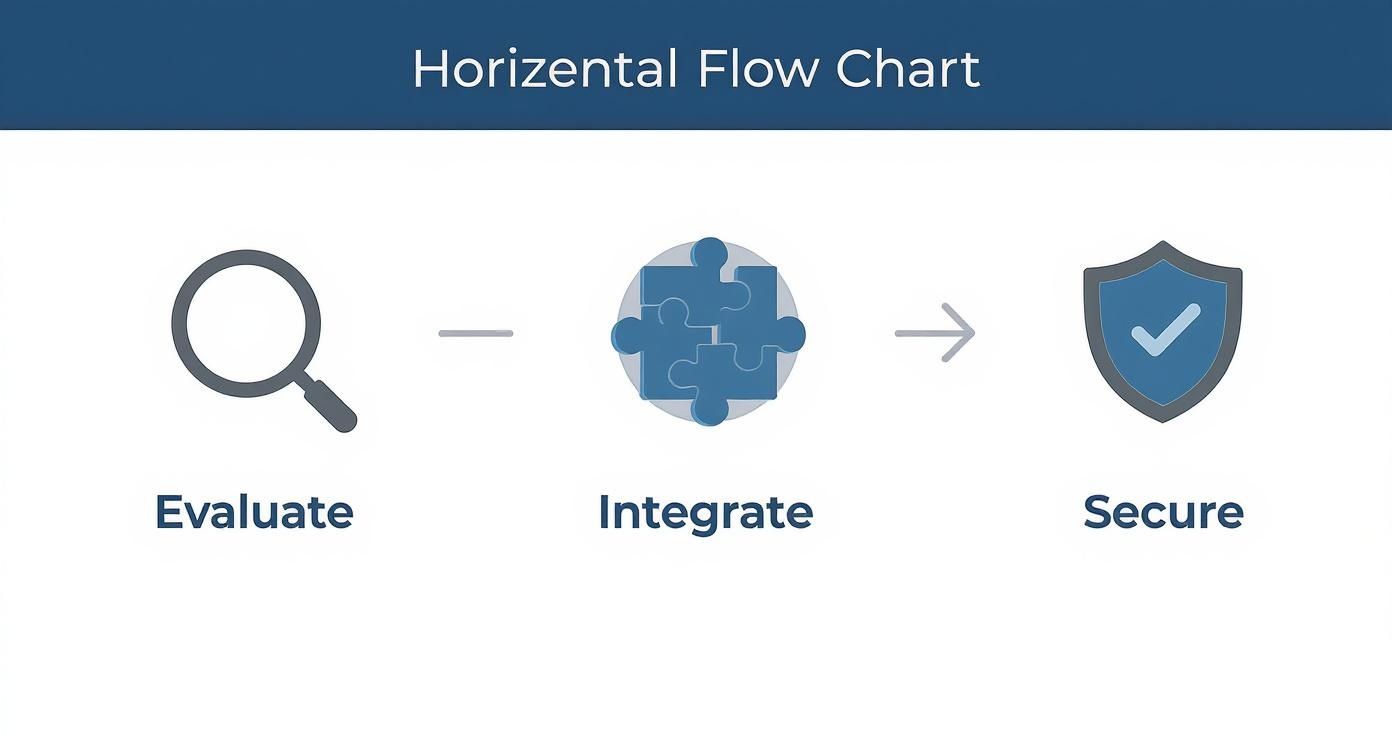
As you can see, a successful launch is all about the prep work. It’s about ensuring the system truly fits how your club operates and, just as importantly, keeps your members' data safe.
Your Phased Rollout Plan
Once your data is clean and ready to go, you can dive into the setup and training. This is where you get to customize the system to match your club’s specific rules and quirks. Don't rush this part. Getting the details right here will save you from a ton of phone calls and emails later on.
A typical implementation timeline breaks down into four main stages:
- Data & Planning (1-2 Weeks): This is your foundation. Gather all your member data, schedules, and booking rules. It's the perfect time to clean up those spreadsheets and finalize your membership packages.
- System Configuration (1 Week): Now for the fun part. You’ll start plugging all that clean data into the new platform. This means setting up your booking windows, pricing rules, and connecting your payment processor. This is all handled in the software’s admin area, and a good back office management system gives you total control over these settings.
- Staff Training (3-5 Days): Your team needs to feel like pros with the new tool before your members ever see it. Run some hands-on training sessions for your front desk staff and coaches. Focus on the everyday tasks, like making a reservation, checking a member in, or processing a payment.
- Member Launch & Support (Ongoing): It’s go-time! Announce the new system to your members, highlighting how much easier it will make their lives. Be ready for a support period where staff are on hand to answer questions as everyone gets used to the new (and better) way of booking courts.
Measuring Success and Avoiding Common Pitfalls
Getting your new court reservation system live is a huge win, but it’s just the starting line. The real magic happens when you start measuring its impact and skillfully sidestep the common mistakes that can trip up even the best-run clubs. Success isn't just about flipping a switch on new software; it's about weaving it into the very fabric of your club's growth.
Figuring out the return on your investment (ROI) means looking at both the hard numbers and the "soft" benefits, which are just as crucial. On the numbers side, the data should tell a story of clear, undeniable improvement.
Calculating Your Tangible ROI
The most direct way to see if your investment is working is to dive into the financial and operational metrics. Your system’s analytics dashboard is your new best friend here, giving you solid proof that you made the right call.
You’ll want to keep a close eye on a few key metrics:
- Increased Booking Revenue: Is the total from court fees climbing month over month? A great system makes booking so frictionless that you should see a natural uptick in court usage.
- Reduced Administrative Hours: Tally up the hours your staff gets back from not having to answer booking calls or manually punch in payments. That time can now be poured into what really matters: creating an amazing member experience.
- Higher Program Enrollment: Check the sign-up rates for your clinics, private lessons, and tournaments. When you make it dead simple for members to register online, participation almost always shoots up.
Avoiding Common Post-Launch Mistakes
Even the slickest software can fall flat if it’s not managed well after launch. Too many clubs stumble into the same predictable traps, leaving tons of value on the table. Knowing what these pitfalls are is the first step to avoiding them entirely.
A common mistake is treating the system as just a digital calendar. It's so much more. A modern court reservation system is a powerful business engine. Failing to use its analytics and communication features is like buying a new smartphone and only using it to make calls.
Be on the lookout for these classic missteps:
- Underutilizing Analytics: Don't let that data collect dust. Regularly check your reports on peak hours, popular courts, and member activity. This is gold—it helps you make smarter decisions about scheduling, programming, and even pricing.
- Poor Member Onboarding: A simple "we have a new system" email won't cut it. You have to actively show members what they can do. Promote cool features like booking a lesson with their favorite pro or signing up for the next tournament with one click.
- Neglecting Staff Training: This isn't a one-and-done deal. As your system gets new features or new staff members come on board, make sure everyone is confident and capable of using the platform to its full potential.
Frequently Asked Questions
When you're looking into a new tennis court reservation system, a few questions always pop up. Here are the straight-up answers to what club managers like you are asking.
How Much Does a System Cost?
You'll find that pricing is all over the map, so it's smart to look past the initial price tag. Most companies will offer either a flat monthly fee or a model that charges you based on how many transactions you process.
The key is to ask for a full breakdown. Get the numbers on setup fees, monthly subscriptions, payment processing rates, and any add-on costs for features like a white-label mobile app. This is the only way to see the true cost and avoid nasty surprises down the road.
Here's something to think about: it's about value, not just cost. A system that’s a bit pricier but manages to boost your court usage by 20% and slash your admin time in half will give you a much better return than just picking the cheapest option off the shelf.
Can It Handle Our Club's Complex Rules?
Absolutely. In fact, this is where a modern tennis court reservation system really shines. A good one is built to be flexible, letting you set up detailed rules that perfectly match how your club operates.
For example, you should easily be able to configure:
- Tiered Booking Windows: Let your premium members book courts 14 days out, while standard members get a 7-day window.
- Court-Specific Rules: Block out certain courts for lessons, league play, or maintenance at specific times of the day.
- Guest Policies: Automatically handle the rules and fees for members who bring guests, taking care of it all right at checkout.
This kind of control means the system works for you, not the other way around.
How Difficult Is the Training and Onboarding?
The best platforms are designed to feel natural for everyone—from your front desk staff who live on their computers to members who aren't so comfortable with new apps.
A solid provider will walk you through the entire setup. This should include proper training for your staff and even some ready-made marketing materials to help you announce the new system to your members. At the end of the day, a clean, simple interface is what gets everyone on board quickly and makes the switch feel like a breeze.
Ready to see how a modern, white-label booking platform can change the game for your club's operations and member experience? Discover Book & Go and schedule your personalized demo today.