Gone are the days of phoning a club, crossing your fingers for an open court, and scribbling your name in a dusty logbook. The world of booking a badminton court has completely transformed. Today, a solid digital platform isn't just a nice-to-have; it's the engine that drives a successful facility, turning a clunky, frustrating process into a few quick taps on a phone.
From Phone Tag to Seamless Taps
Making the jump from paper logs to a smart digital system solves the nagging problems that have bothered both players and managers for years. For players, it means they can see court availability instantly, pay securely online, and book a game whenever the mood strikes—no more waiting for business hours.
For you, the operator, it puts an end to the headaches of double bookings, constant phone interruptions, and chasing down payments.
Think of a great booking system as your facility's operational brain. It’s the central hub that handles your schedule, payments, and player communication, freeing you up to focus on what really matters: building a thriving badminton community.
The Modern Framework for Court Bookings
This guide lays out a complete framework for setting up and fine-tuning a system that not only makes life easier but also boosts your revenue and keeps players coming back. We'll break down the essential pieces that make a modern booking system click, turning potential chaos into smooth, efficient operations.
We're going to cover how to:
- Solve the real challenges—like maximizing court usage and killing off scheduling conflicts for good.
- Create a frictionless experience for your players, making the booking process fast, intuitive, and dead simple.
- Boost revenue and loyalty by using smart pricing, memberships, and promos that encourage more court time.
This digital shift is happening for a reason: the sport is booming. The global badminton market is already valued at an estimated USD 3,751.6 million and continues to grow. That surge in popularity means a surge in demand for courts—and for an easy way to book them.
A well-designed booking system is the silent partner in your business. It works 24/7 to fill your courts, manage your cash flow, and deliver the professional experience that modern players expect.
Why Digital Management is No Longer Optional
In today's competitive market, sticking with outdated methods is like leaving money on the table. A powerful digital platform for the booking of badminton courts is one of your most valuable assets. It automates the tedious admin work, gives you priceless data on peak hours and player habits, and helps you make smarter business decisions.
By understanding the key features that matter in smart booking systems, you can build a rock-solid foundation for operational excellence. This guide will walk you through every step, making sure your facility is set up for success.
Designing Your Scheduling and Booking Rules

Think of your court schedule like a game of Tetris. Every booking needs to slot in perfectly to maximize court time and avoid those costly empty gaps. Designing a smart, clear set of booking rules is the foundation for this kind of efficiency, creating a system that’s fair and flexible for everyone who wants to play.
This isn't just about preventing double-bookings. It's about strategically managing your single most valuable asset: your court time. A solid framework helps you juggle casual players, dedicated leagues, and one-off events, making sure your courts are always generating value. The goal is a system that feels effortless for your players but works incredibly hard for your bottom line.
Defining Your Core Booking Types
Your players aren't all the same, so your booking options shouldn't be either. A one-size-fits-all approach is a missed opportunity for both players and revenue. The trick is to structure your offerings to fit different needs, whether it's for a quick friendly match or a recurring coaching session.
Here are the essential booking types every facility should consider:
- Pay-and-Play (Single Bookings): This is your classic walk-in-and-play option where someone books a single court for a game. It's the bread and butter for attracting new and casual players.
- Block Bookings: Think recurring reservations—every Tuesday night for a month, for example. These are perfect for corporate leagues, school teams, or just groups of friends who play regularly. The big win for you? Guaranteed, consistent income.
- Lessons and Coaching Clinics: These are dedicated slots reserved for individual or group coaching. They often come with special rules, like only being bookable by your facility's certified coaches.
- Tournaments and Events: Big one-off bookings that might tie up multiple courts for a whole day or weekend. These require a separate process and usually involve custom pricing and policies.
By defining these categories, you can create specific rules and pricing for each. This streamlines the entire booking of badminton courts for everyone and stops a local league's regular slot from clashing with a last-minute game between two members.
Setting Time Slots and Buffer Periods
How you slice up the day has a massive impact on both your court availability and how happy your players are. The length of each time slot is a critical decision. A 60-minute slot is pretty standard, but some clubs have found success with 45-minute or 90-minute options, depending on their players' habits. Shorter slots can increase turnover, while longer ones appeal to serious players who want a proper practice session.
Just as important is the time between bookings. A buffer period, even just 5-10 minutes, is absolutely essential for things to run smoothly.
Think of a buffer period as the air traffic control for your courts. It prevents one game from backing up the next, giving players time to gather their belongings, sweep the court if needed, and clear out before the next group arrives.
This tiny window of time prevents friction between players and keeps your schedule on track, which is crucial during peak hours. Without it, a single game running late can trigger a domino effect of delays and frustration for the rest of the evening.
Establishing Clear Booking Windows
A "booking window" simply defines how far in advance a player can reserve a court. It’s a simple rule, but it's a powerful tool for managing demand and rewarding loyalty. For most facilities, a tiered approach works best.
Here’s a common and effective structure:
- Members: Can book 14 days in advance. This is a huge perk of membership, giving your most loyal players first dibs on those prime-time slots.
- Non-Members (Pay-and-Play): Can book 7 days in advance. This gives casual players plenty of time to get a court while still prioritizing your member base.
- Coaches and Leagues: May get access to booking windows of 30 days or more for their block bookings, which they need to plan their seasons effectively.
This tiered system creates a clear value proposition for becoming a member and helps you manage court demand like a pro. It ensures your most committed players feel valued while keeping your doors open to the wider community—the perfect balance for a healthy, thriving facility.
01 / An open slot at 19:00. Players see it live in your club’s app.
Crafting a Smart Pricing Strategy for Your Courts
Think of your pricing structure as more than just a way to pay the bills. It's one of the most powerful levers you can pull to manage court usage, fill up empty slots, and ultimately, grow your revenue. If you're stuck on a simple flat hourly rate, you're leaving money on the table. A smarter approach keeps your facility competitive, financially sound, and buzzing with players.
The right strategy can turn those quiet Tuesday mornings into a steady stream of income and transform first-time visitors into loyal members. It all starts with getting a feel for the natural rhythm of your facility—understanding when courts are in high demand and when they're gathering dust.
Moving Beyond the Flat Rate with Dynamic Pricing
A flat rate is easy, but it’s rarely the most profitable. Charging the same for a court at 10 AM on a weekday as you do for a 7 PM primetime slot on a Thursday just doesn’t make sense. This is where dynamic pricing comes in. The idea is simple: charge more when demand is high and less when it's low.
This approach delivers two massive wins:
- You maximize revenue. During peak hours, players are more than willing to pay a premium for a court. You should capture that value.
- You increase utilization. Lower off-peak prices are a magnet for students, remote workers, and anyone with a flexible schedule, filling courts that would otherwise sit empty.
The first step is to map out your peak and off-peak times. Peak hours are almost always evenings (after 5 PM) and weekends. Off-peak is typically weekday mornings and afternoons. If you want to dive deeper into setting this up, you can explore some advanced dynamic pricing strategies for sports courts.
Think of your court time like airline tickets. The price for a last-minute flight on a holiday weekend is always higher than a mid-week flight booked months in advance. Your court pricing should follow the same logic of supply and demand.
To give you a clearer picture, here’s what a simple tiered pricing model might look like:
Sample Pricing Tiers for Badminton Courts
| Time Slot | Member Price (per hour) | Non-Member Price (per hour) | Booking Window |
|---|---|---|---|
| Peak (Weekdays 5 PM - 10 PM) | $25 | $35 | 14 Days |
| Peak (Weekends 9 AM - 6 PM) | $25 | $35 | 14 Days |
| Off-Peak (Weekdays 9 AM - 5 PM) | $15 | $22 | 7 Days |
| Super Off-Peak (Weekdays 6 AM - 9 AM) | $10 | $18 | 7 Days |
This kind of structure immediately encourages players to consider off-peak times while ensuring you're fairly compensated for high-demand slots. It's a win-win.
Building Loyalty with Membership Tiers
While pay-per-play is fantastic for getting new faces in the door, memberships are what create a stable, predictable revenue base. By creating a few different membership tiers, you can appeal to everyone from the casual weekend player to the die-hard competitor who’s at the club every day.
Each tier needs to offer a clear and compelling jump in value. For instance:
- Basic Tier: A simple, entry-level option that offers a modest discount on all court bookings.
- Premium Tier: A more significant discount, plus perks like an extended booking window (maybe 14 days instead of 7) and a free guest pass each month.
- VIP Tier: The all-access pass. This could include unlimited court time during off-peak hours, priority booking for tournaments, and maybe even free racket rentals.
A tiered system like this gives players a compelling reason to commit. It shifts the booking of badminton courts from a one-off transaction into a long-term relationship, building a loyal community that provides the consistent income you can build a business on.
Increasing Value with Bundles and Add-Ons
Don't let the transaction end when the court is booked. Every single reservation is an opportunity to offer more value to your players—and increase your revenue in the process. Weaving relevant add-ons directly into the booking flow is an easy way to do this.
Consider what you could bundle:
- Equipment Rentals: Let players reserve rackets and shuttlecocks right when they book their court. No more scrambling when they arrive.
- Coaching Packages: Offer a "Book & Learn" deal that packages court time with a 30-minute mini-lesson from a pro.
- Refreshment Packs: Allow players to pre-order water, sports drinks, or snacks so they’re waiting for them courtside.
The demand is definitely there. In Singapore alone, the number of badminton court bookings hit roughly 961,760 in 2023, a huge leap from the year before. You can see more data on this growth trend on Statista. This isn't just a local trend; it shows a massive global opportunity. By pricing your courts and services intelligently, you put your facility in the perfect position to capture this rising demand.
Choosing the Right Technology for Court Management
Let's be honest, the right technology is the secret sauce to running a modern, profitable badminton facility. It's the central nervous system connecting your schedule, your players, and your revenue into one smooth operation. This isn't just about adding a fancy booking button to your website; it's a strategic decision that directly shapes your player experience and your bottom line.
Think of your booking software as your digital front-desk manager—one that works 24/7 without needing a coffee break. It handles all the tedious admin work that used to eat up your day, freeing you up to focus on what really matters: growing your business. From taking online payments to firing off automated reminders, the right platform makes booking a badminton court ridiculously easy for everyone involved.
Core Features of a Modern Booking Platform
Not all software is built the same. When you're shopping around, there are a few non-negotiable features that absolutely must be there. These are the tools that will save you the most time and prevent the biggest headaches down the line.
A solid system needs to have:
- A Real-Time Availability Calendar: This is the heart of your entire operation. Players need to see exactly which courts are free and when, all without picking up the phone. It absolutely has to update instantly to kill the risk of double bookings.
- Integrated Payment Gateways: Taking secure, online payments is no longer a "nice-to-have"—it's an expectation. Look for platforms that plug into trusted providers like Stripe. Getting players to pay upfront drastically cuts down on no-shows and saves you from the awkward task of chasing down payments.
- Automated Reminders: A simple email or SMS reminder is surprisingly powerful for wiping out forgotten bookings. A good system sends these out on autopilot, usually 24-48 hours before a game, protecting your revenue from those empty, unpaid slots.
These core features aren't just separate tools; they work together to create a reliable, professional experience. In fact, research into badminton court management systems has shown that platforms offering real-time booking and tracking can boost court utilization by as much as 25% just by cutting down the dead time between games.
Off-the-Shelf SaaS vs. Custom-Built Solutions
One of the biggest tech decisions you'll face is whether to go with a ready-made Software-as-a-Service (SaaS) platform or build something from scratch. Each path has its pros and cons, and the right choice depends entirely on your facility's scale and ambition.
A SaaS platform is like leasing a high-performance car. You get a feature-packed, super-reliable system for a predictable monthly fee, and the provider handles all the messy stuff like updates, security, and maintenance. For most single-location clubs and small-to-midsize facilities, this is the way to go. It's fast, cost-effective, and gets you a professional-grade system without the massive upfront investment.
A custom-built solution is like designing a car from the ground up. You get total control over every single detail, but it demands a huge investment of time and money, not to mention ongoing costs for maintenance.
A custom solution might make sense for a massive, multi-location franchise with weirdly specific operational needs that no off-the-shelf software can handle. But for the vast majority of clubs, a proven SaaS platform gives you all the power you need without the financial risk and technical headaches of building your own.
Essential System Integrations
Your booking system shouldn't be an island. Its real power is unlocked when it talks to the other tools you use to run your business. These connections create a single, unified workflow where data moves seamlessly between all the different parts of your operation.
Key integrations to look for include:
- Accounting Software: Automatically sync your sales data with tools like QuickBooks or Xero to make bookkeeping and financial reporting a breeze.
- Member Databases: Link booking activity to player profiles. This lets you track who's playing when, manage memberships effectively, and even send out personalized promotions.
- Keyless Entry Systems: If you have automated access, this is a game-changer. The booking system can generate and send temporary access codes to players that only work for their specific time slot, tightening security and making check-in effortless.
When your tech stack works in harmony, it doesn't just simplify your life as a manager—it creates a genuinely modern and seamless experience for your players.
Optimizing the Player Booking Journey
Even the most sophisticated court management system is useless if players find it clunky or confusing. A frustrating booking process is a guaranteed way to kill revenue. To really nail the experience, you have to put yourself in your players' shoes and design a journey that feels intuitive, transparent, and incredibly fast from start to finish.
The goal is to eliminate friction. Think of the booking journey as a clear, well-lit path—any unnecessary steps, hidden fees, or confusing layouts are just obstacles that make people turn back. A great interface makes the booking of badminton courts so simple that it becomes a natural, effortless habit for your customers.
To get more people completing their bookings, it’s essential to apply powerful conversion rate optimization techniques at every single stage. Even a tiny improvement in usability can lead to a big jump in reservations.
The Anatomy of a Great Booking Interface
A world-class booking experience isn't an accident; it’s the result of thoughtful design focused entirely on the user. The interface should feel like it's guiding players toward their goal—securing a court—with almost zero effort and total clarity. This all comes down to a few key design principles that build trust and get rid of any hesitation.
Here’s what a friction-free booking flow actually looks like in practice:
- Clean Visual Layout: Players need to see a simple, grid-style view of the courts and available time slots. Using color-coding—like green for available and gray for booked—gives them an instant visual summary that’s easy to understand in a split second.
- Transparent Upfront Pricing: Never, ever make players wait until the final checkout page to see the cost. Prices for peak, off-peak, member, and non-member slots should be displayed right on the calendar view. Hiding costs is the fastest way to break a customer's trust.
- Minimal Clicks to Checkout: The perfect process should take no more than three or four clicks: select a time, confirm details, and pay. Every extra field they have to fill out or page they have to load is another chance for them to give up and leave.
This flow chart maps out the core steps a player goes through: picking a time on the calendar, completing the payment, and getting automated reminders.
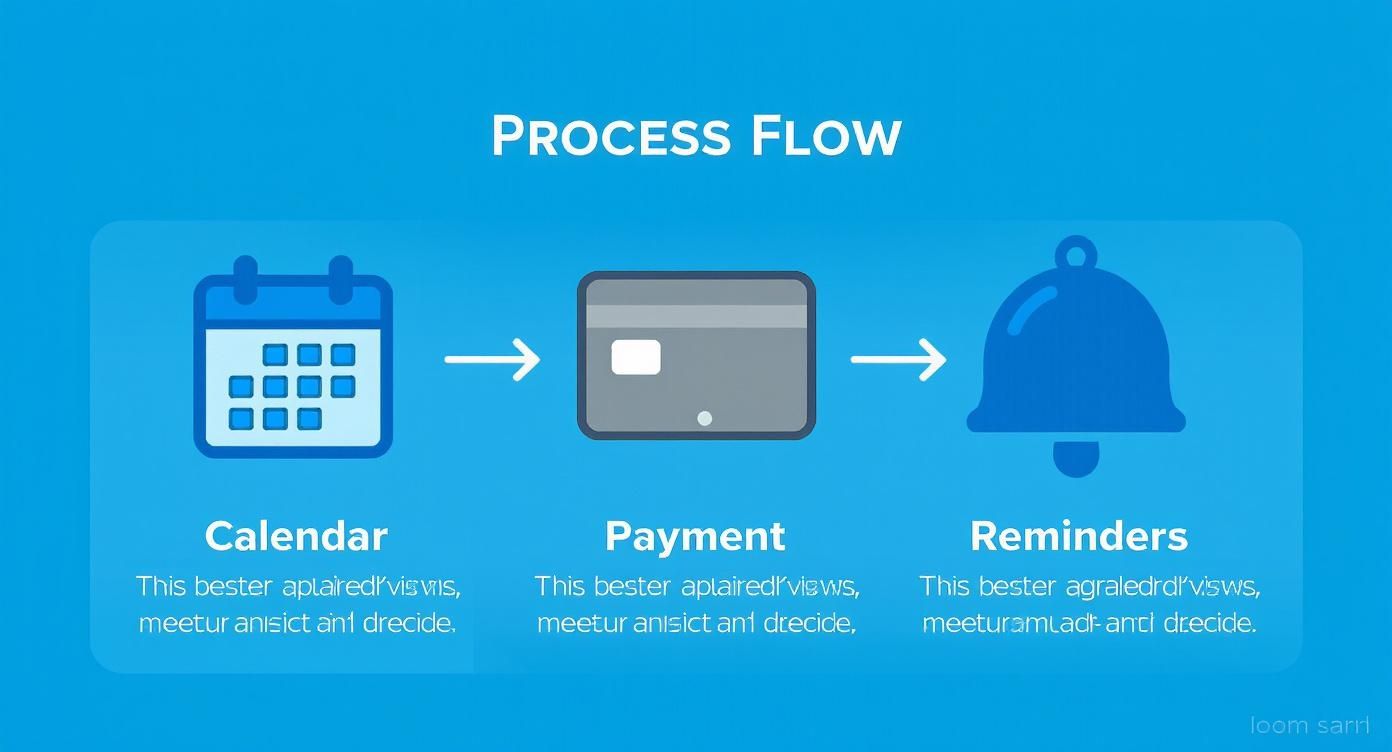
It shows that a successful booking journey depends on seamlessly integrating scheduling, secure payments, and proactive communication to create an experience players can rely on.
A UX Checklist for Your Booking Platform
So, how does your current system stack up? Use this quick checklist to audit your platform and find the weak spots. Go through the process as if you’re a brand-new player trying to book a court for the very first time.
A booking abandoned at the last second is more than just a lost sale—it's a sign of a broken experience. Identifying and fixing these friction points is one of the highest-impact activities you can undertake.
User Experience Audit:
- Is it mobile-friendly? Does the booking page look and work perfectly on a smartphone? Most of your players are booking on the go.
- Is guest checkout an option? Forcing new players to create a full account before they can book is a massive barrier. Always offer a quick guest checkout.
- Are confirmation messages clear? Does the player get an immediate email or SMS confirming their booking details, including the court number, time, and a payment receipt?
- Is it easy to cancel or reschedule? Can players manage their own bookings online without having to call the front desk? A clear, self-service option shows you respect their time.
By systematically going through these points, you can turn your booking system from a simple utility into a powerful tool for keeping customers happy. A smooth, reliable booking journey shows players you value their time and cements your facility's reputation for being professional and easy to do business with.
Using Data to Maximize Court Utilization
Don’t just manage your courts—optimize them. Every booking, cancellation, and membership sign-up is a breadcrumb, a piece of a story that reveals how your business is really doing. If you learn to read these stories, you can turn raw booking data into your sharpest strategic tool, making smarter decisions that keep courts full and revenues climbing.
This isn't about needing a PhD in statistics or getting lost in complex algorithms. It’s about paying attention to a few powerful numbers that act as the vital signs of your facility. A deep dive into your company data analytics is what separates reactive management from proactive, strategic optimization.
Defining Your Key Performance Indicators
Before you can improve, you need to know what to measure. Focusing on a handful of Key Performance Indicators (KPIs) gives you a clear, immediate snapshot of your business's health. Think of them as your facility's dashboard—they tell you where you’re winning and where you’ve got room to grow.
Here are the essential metrics every single court manager should be tracking:
- Court Utilization Rate: This is the big one. It’s the percentage of your available court time that is actually booked and paid for. A high rate is the clearest sign of a healthy, efficient operation.
- Peak Hour Trends: This metric pinpoints the exact days and times when demand is through the roof. Knowing your prime time is step one for smart, dynamic pricing.
- Booking Lead Time: How far in advance are your players booking? Long lead times suggest solid, predictable demand, while short ones might mean you're relying on last-minute decisions.
- Cancellation & No-Show Rate: Keep a close eye on this number. If it starts creeping up, it could be an early warning of problems with your booking policy, reminder system, or even overall player satisfaction.
When you track these figures, you stop guessing. You can see with certainty that Tuesday mornings need a promotional push or that your membership perks are successfully driving more advanced bookings.
Turning Metrics into Actionable Insights
Data is completely useless until it inspires action. The real magic happens when you connect these numbers to what’s happening on the ground at your facility. Each metric tells a story, and your job is to listen.
For instance, a low utilization rate on weekday mornings isn’t a failure—it's a massive opportunity. That data is practically screaming at you to launch an "Early Bird Special," a student discount, or a corporate wellness package to fill those empty slots. A high cancellation rate for weekend bookings? Maybe that's a signal that your 24-hour cancellation policy is a bit too forgiving for those high-demand times.
Think of your data as a direct feedback loop from your players. The numbers tell you what they’re doing, and your strategic responses show them you're paying attention. This cycle of measuring, analyzing, and acting is the secret to world-class facility management.
Key Performance Indicators for Court Management
To really put this into practice, you need to understand what each metric reveals. This table breaks down the most important KPIs, showing you how to calculate them and what they mean for your business strategy.
| Metric | How to Calculate It | What It Tells You |
|---|---|---|
| Court Utilization Rate | (Total Hours Booked / Total Hours Available) x 100 | Are your courts generating maximum revenue, or are there significant empty periods you can fill? |
| Peak Hour Identification | Track booking volume by hour and day of the week. | When can you confidently charge premium rates, and when should you offer discounts to drive traffic? |
| Booking Lead Time | Average number of days between the booking date and the play date. | How predictable is your revenue? Are players planning ahead, or are most of your bookings last-minute? |
| Player Lifetime Value (PLV) | Average revenue a single player generates over their entire time with your facility. | Who are your most valuable, loyal customers? How can you reward them and encourage others to be more like them? |
Calculating these figures gives you a powerful dashboard for making decisions. You can even use a tool like our free revenue calculator to see how small tweaks to these metrics can have a huge impact on your bottom line.
Using Data for Strategic Growth
Once you’ve got the basics down, you can use data to plan for the future. By analyzing Player Lifetime Value (PLV), for example, you can identify your most dedicated customers. This allows you to create exclusive perks or loyalty programs to keep them coming back—a strategy that's far more cost-effective than constantly chasing new players.
Similarly, if you have different court types, tracking their individual booking data can inform future expansion. Are your singles courts always packed while the doubles courts sit empty? That's not just a hunch; it's hard data you can take to the bank when planning your next investment.
Ultimately, a data-driven approach ensures every decision you make about the booking of badminton courts is grounded in reality, not guesswork, paving the way for smart, sustainable growth.
Common Questions About Running a Badminton Club
If you've been managing a badminton facility for a while, you know the same questions pop up over and over. From handling no-shows to filling those dreaded off-peak slots, every club owner faces the same operational puzzles. Let's get straight to some practical, real-world answers.
How Should I Handle No-Shows and Cancellations?
The best defense is a good offense: a firm but fair cancellation policy. The first step is to require pre-payment for all non-member bookings. That one change alone will drastically cut down on casual no-shows.
Next, you need a clear cutoff time for free cancellations—24 hours is the industry standard. Anyone who cancels after that point should expect to pay a partial or full fee. Back this up with automated email and SMS reminders sent 48 hours before their booking. It gives players plenty of notice and protects your revenue from last-minute holes in the schedule.
A strong cancellation policy isn't about punishing players; it's about valuing your court time. It ensures that players who genuinely want to play can get a spot, and it protects your business from predictable revenue loss.
Should I Offer Memberships or Just Pay-Per-Play?
For nearly every facility, a hybrid model is the way to go. You absolutely need a pay-per-play option. It's the front door to your club, welcoming new faces, casual players, and visitors with the lowest possible barrier to entry.
But memberships are what build your community and create a reliable revenue baseline. The trick is to make the membership package a genuinely great deal. Don't just slap a discount on court time and call it a day. Bundle in real, valuable perks that make people feel like insiders:
- Advance Booking Privileges: Let members book 14 days out, while non-members can only book 7 days ahead.
- Exclusive Access: Run member-only leagues, tournaments, or special coaching clinics.
- Guest Passes: Give members a free guest pass or two each month so they can bring a friend.
How Can I Boost Bookings During Off-Peak Hours?
Getting people onto the courts on a Tuesday morning takes a bit of creativity. Your most powerful tool here is dynamic pricing. Offering a steep discount for off-peak times is often enough to attract students, remote workers, or retirees who have more flexible schedules.
You can also get proactive with targeted promotions. Think about launching an "Early Bird" special for morning players or a "Lunchtime Smash Pass" for a quick game during the workday. Even better, look outside your existing player base. Partnering with local schools for after-school programs or with nearby companies for corporate wellness events can fill your courts and bring a whole new audience through your doors.
Ready to eliminate booking headaches and create a seamless experience for your players? Book & Go provides a powerful, white-label platform that combines a branded mobile app with a full-featured back office to streamline your entire operation. Discover how Book & Go can transform your club today.