To get a fair game of squash anywhere in the world, the court you play on has to be built to exacting standards. A regulation singles court is a precisely defined space, measuring 9.75 meters (32 feet) long by 6.4 meters (21 feet) wide. These dimensions are what create that classic, fast-paced feel of the game we all know.
Standard Singles Squash Court Dimensions
Every single official match, from your local club league to the PSA World Tour, is played inside a rectangular box governed by strict, official measurements. The World Squash Federation (WSF) sets these standards, and they're what guarantee a consistent playing field no matter where you are. Even a tiny deviation in a court's size can completely change how the ball rebounds, how players have to move, and the overall strategy of a match.
The funny thing is, these dimensions have been locked in for decades. A singles court is exactly 9.75 meters (9750 mm) long and 6.4 meters (6400 mm) wide, with a diagonal of 11.665 meters. The builders have very little wiggle room—a tolerance of just ±10 mm—which ensures every court plays virtually identically. It's a testament to how well the original design worked. If you're interested in the history, the team at ASB SquashCourts have been building courts for 50 years and have seen it all.
For a quick summary of these critical measurements, here's a simple table.
Official WSF Singles Squash Court Dimensions
| Measurement | Metric (meters) | Imperial (feet) |
|---|---|---|
| Length | 9.75 m | 32.0 ft |
| Width | 6.40 m | 21.0 ft |
| Diagonal | 11.665 m | 38.27 ft |
These numbers—length, width, and diagonal—are the absolute foundation of the game's playing area.
Key Court Measurements at a Glance
For any player, club manager, or court builder, getting these core numbers right is the first step. The length gives you the room for those deep, driving shots to the back corners, while the width defines the angles you can play for hitting a cross-court nick or a punishing boast.
The infographic below puts the three most important dimensions into a simple visual.
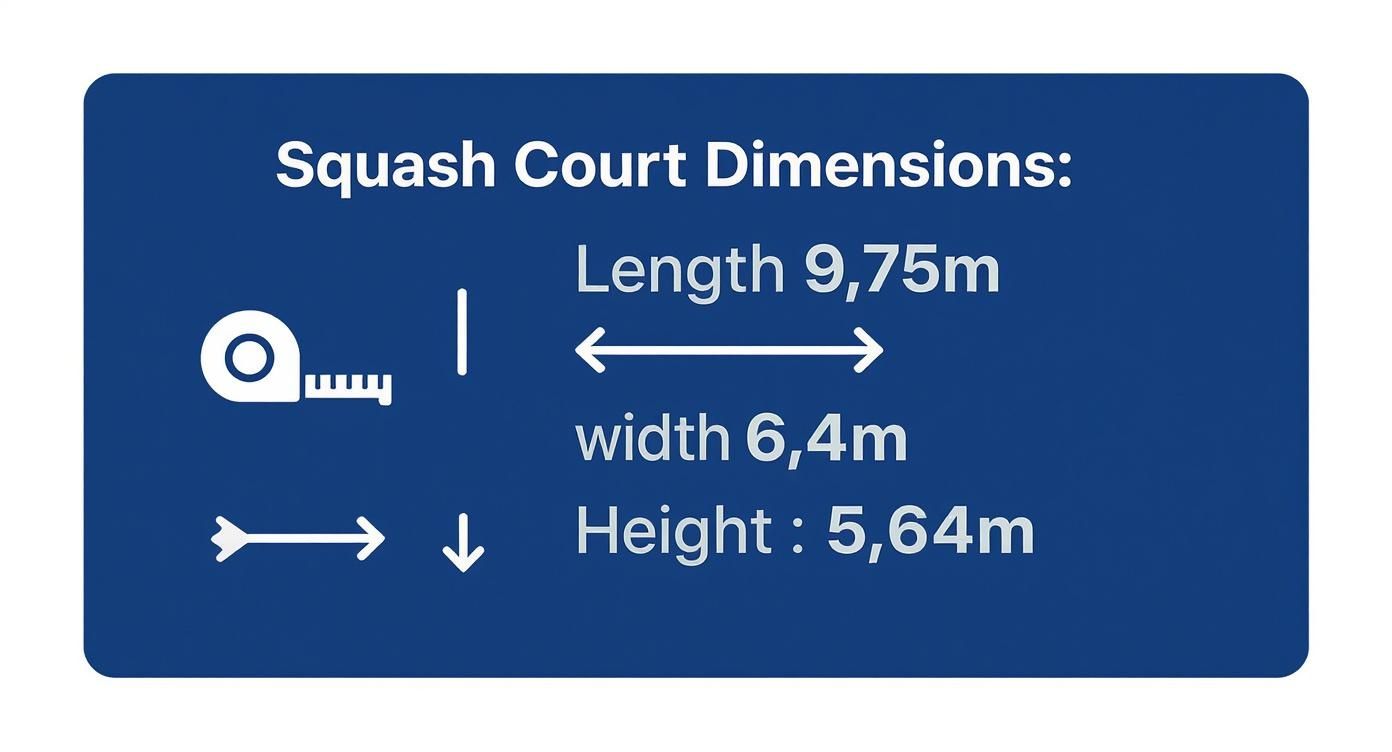
It really boils down to this: a 9.75m length, a 6.4m width, and a minimum clear height of 5.64m from the floor to the lowest obstruction. These three measurements create the box where every rally is fought and won.
The Role of Each Playing Surface
The court isn't just an empty box; its four walls and the floor are all active playing surfaces, and each one has a specific job.
- Front Wall: This is your primary target. After the serve, every shot in a rally has to hit this wall before it hits the floor.
- Side Walls: You use these for strategy. They're perfect for playing angled shots (boasts) to wrong-foot your opponent or for hitting rails that run tight along the wall, making them difficult to return.
- Back Wall: This is often a glass wall for spectators, and it's your get-out-of-jail card. You use it for defensive lobs or to recover when you're out of position and need to get the ball back to the front wall.
- Floor: The ball can only bounce once on the floor before you have to hit it. Simple as that.
Knowing how to use these surfaces is just as crucial as knowing the court's dimensions. Together, they create the boundaries and the endless strategic possibilities that make squash so addictive.
Deconstructing All Court Lines and Markings
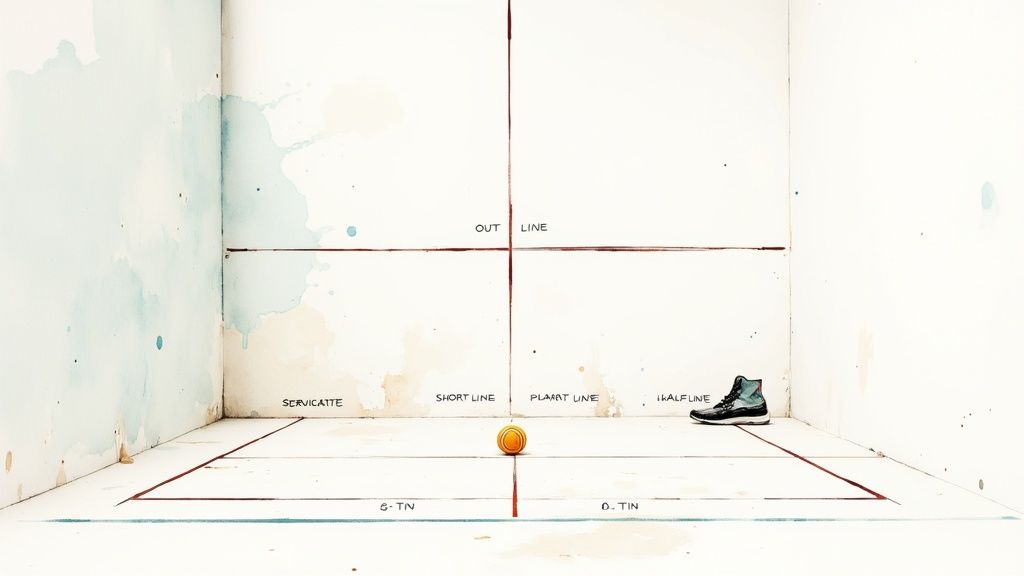
Beyond the overall dimensions, a whole network of lines and markings dictates the flow of every single game. From the serve to the final rally, these lines—all specified to be 50mm (2 inches) wide and usually painted red for high visibility—turn an empty box into a strategic grid.
Each line has a job to do, and understanding them is non-negotiable for players and absolutely critical for anyone building a court.
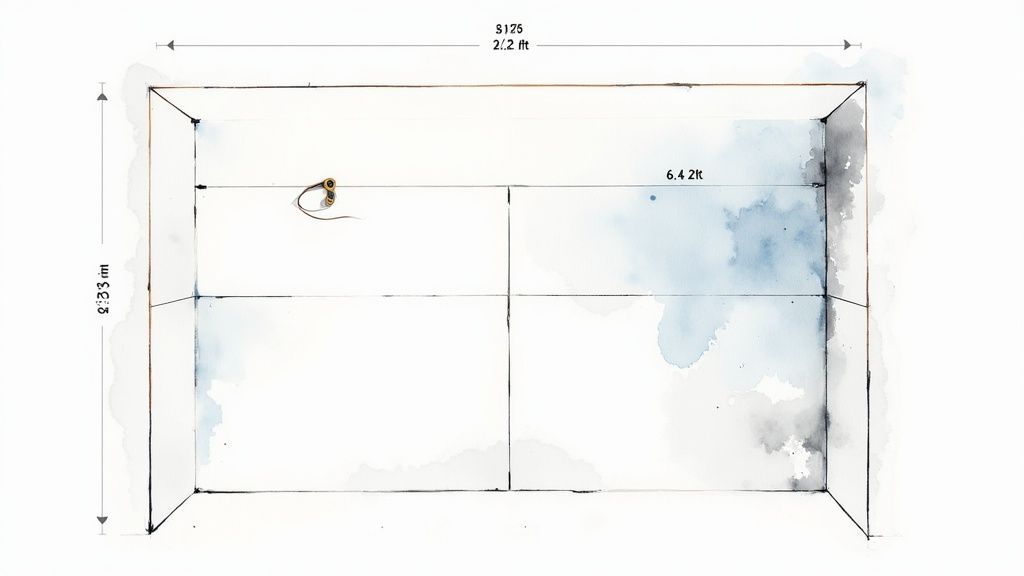
Getting these markings exactly right is a matter of precision. For builders, a solid grasp of architectural detail drawings is essential to ensure every court they build is up to international standards. There's no room for guesswork here.
Front Wall and Lower Boundary Markings
The front wall is the heart of the action, and its horizontal lines define the legal playing area for every shot.
- Out Line: This is the top boundary on the front wall, set at a height of 4.57 meters (15 feet). If the ball hits on or above this line, it's out. The line continues along the side walls, sloping down to meet the out line on the back wall.
- Service Line: Sitting between the out line and the tin, this line is 1.78 meters (5 feet 10 inches) from the floor. A legal serve must strike the front wall above this line but below the out line.
- The 'Tin': Probably the most famous marking in squash. It's a metal strip at the very bottom of the front wall, and its top edge is the lower limit of play. For standard play, the tin is 480mm (19 inches) high. In professional tournaments, you'll often see it lowered to 430mm (17 inches) to make the target smaller and the game tougher. Hitting the tin means the point is lost.
Key Takeaway: The tin is more than just a line; it's a physical and audible boundary. That unmistakable "thwack" sound gives immediate, undeniable feedback that your shot was too low. It removes all doubt for players and refs alike.
Floor Lines and Service Zones
The markings on the floor are all about the serve and controlling the court's geography.
- Short Line: Running parallel to the front wall, this line is 4.26 meters (14 feet) back from it. When you serve, the ball has to land behind this line (in the opposite quarter court) to be considered in.
- Half-Court Line: This line bisects the back of the court, running from the back wall right up to the short line. It creates the left and right quarter courts.
- Service Boxes: You'll find these two 1.6m x 1.6m (5 feet 3 inches) squares tucked into the corners where the short line meets the side walls. When serving, at least part of one foot must be inside this box.
01 / An open slot at 19:00. Players see it live in your club’s app.
Doubles Squash Court Sizes and Gameplay Impact
Jumping from singles to doubles squash is a whole different ball game, and it starts with the court itself. A singles court is an intense, gladiatorial box. A doubles court? It's a sprawling arena built to handle four players moving at full tilt. That extra space isn't just a nice-to-have; it's absolutely essential for safety and a fluid, fast-paced match.
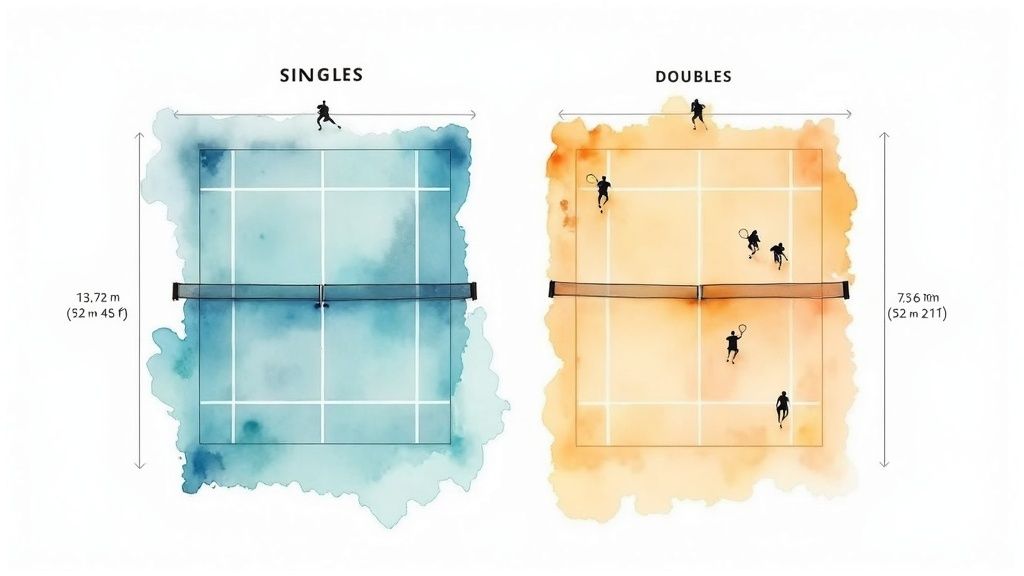
This bigger version of the game naturally comes with its own unique set of squash court sizes. A regulation doubles court stretches out to 13.72 meters (45 feet) long and 7.62 meters (25 feet) wide. This design is no accident—it’s carefully planned to manage the chaos of four players. On top of that, the ceiling needs to be higher, with a minimum clearance of at least 7.32 meters (24 feet). If you're interested in the nitty-gritty of how these standards came to be, you can find some great insights into doubles court construction on unsquashable.com, where pioneers in the field share their history.
From Singles to Doubles Gameplay
The sheer size difference completely rewrites the tactical playbook. That extra width opens up a world of new angles. Cross-court drives and clever boasts that would be impossible in singles become standard weapons for pulling your opponents out of position.
With four bodies on court, the game shifts from a battle of individual stamina to a masterclass in teamwork, communication, and controlling key territory. Sure, you cover more ground, but you do it as a synchronized pair, reading your partner’s moves and setting each other up.
This creates a much faster, more dynamic game where quick volleys and smart positioning are king. Players have to rethink their shot selection and movement, making doubles a completely distinct discipline from the familiar rhythm of a singles match. It requires a whole different strategic mindset.
How Court Standardization Shaped Modern Squash
Today, we take the official dimensions of a squash court for granted, but it wasn't always so clear-cut. The sport's early days were a chaotic jumble of inconsistent court sizes, leading to a frustratingly different game depending on where you played. A killer drop shot in one club might be a tin-thwacking error in another.
This lack of uniformity was a huge roadblock for any kind of serious, fair competition. Something had to give. The turning point came in London in January 1923, when members of the Royal Automobile Club sat down and hammered out what would become the standard "English" court. They set the dimensions at 32 feet long by 21 feet wide, a decision that laid the foundation for squash as a global sport. If you're curious about the sport's origins, this colorful history of squash on winningsquash.com is a great read.
The Convergence to a Global Standard
Before everyone got on the same page, there was another major version of the game to contend with: the North American "hardball" court. This variant was noticeably narrower at 18.5 feet wide and, as the name suggests, used a much harder, faster ball. It created a totally different style of play, one that favored raw power over the tactical finesse we see in the modern game.
The old hardball game was a relic of squash's divided past. Its convergence toward the international "softball" standard shows how crucial a unified set of rules and dimensions is for a sport to thrive globally.
Over time, the international "softball" game, played on that wider 21-foot court, just became more popular around the world. The shift to a single set of squash court sizes was what allowed for unified professional tours, consistent coaching, and a playing experience that was the same whether you were in Cairo or Chicago.
This strategic move to standardize was a critical step for growth, not unlike the planning required for other successful racket sports. For instance, getting a new facility off the ground requires meticulous attention to detail, a point well-covered in this ultimate guide to launching a padel club. Ultimately, this unification was essential for squash to become the internationally respected and competitive sport it is today.
Of course, here is the rewritten section:
Why Ceiling Height and Clearance Are Critical
While the court's floor plan gets most of the attention, the vertical space is just as crucial. A low ceiling completely changes the game, making certain shots impossible and instantly disqualifying a court from hosting any sanctioned events. Simply put, getting the vertical clearance right is non-negotiable.
For a standard singles court, the World Squash Federation (WSF) mandates a minimum clear height of 5.64 meters (18.5 feet). This measurement is taken from the finished floor to the lowest hanging obstruction—think light fixtures, ceiling beams, or ventilation ducts. This isn't an arbitrary number; it’s the minimum height needed to allow for high defensive lobs, which are a fundamental part of squash strategy.
Expert Insight: A low ceiling kills the lob. Players are forced into a flat, aggressive hitting game, which eliminates the tactical nuance of resetting a rally or forcing an opponent out of position with a well-placed high ball.
Doubles Courts and Best-Practice Heights
Doubles squash is faster and played across a wider area, so the ceiling height requirement jumps significantly. For a doubles court, you’ll need a minimum clearance of 7.32 meters (24 feet).
Keep in mind, these are the minimums. If you're building a new facility, it's always smart to aim higher. Most premium clubs and tournament-level venues exceed these standards to guarantee an exceptional playing experience and remove any chance of interference.
- Singles Recommended Height: Aim for 6 meters (19.7 feet) or more.
- Doubles Recommended Height: Best to provide 7.5 meters (24.6 feet) or higher.
Ultimately, the ceiling acts as the court's upper "out" line. Any ball hitting an object below the required minimum height is out of play. For club managers and builders, matching these vertical dimensions is just as important as getting the length and width right if you want to build a compliant, top-tier squash facility.
Practical Insights for Court Construction and Management
Knowing the official squash court sizes is one thing, but translating those numbers into a functional, money-making facility is a whole different ball game. For club managers and builders, understanding the real-world implications of these dimensions is what separates a good investment from a bad one. It's about thinking beyond the play lines to the entire facility experience and long-term business strategy.
When you're planning a new facility, the space between the courts is just as critical as the courts themselves. It's a classic rookie mistake to pack courts in too tightly, forgetting about player access, fire exits, and decent viewing areas. Skimping on this ancillary space leads to a cramped, frustrating experience for everyone.
Spatial Planning and Construction Materials
A single court's footprint is straightforward, but for a block of courts, you need to factor in extra width for structural supports and safe walkways. A good rule of thumb is to allow at least an extra 0.5 to 1 meter of circulation space around the entire court block.
Modern construction has also changed how we build courts. While traditional plaster is still around, most new facilities are going with panel systems and glass-back walls for good reason.
- Glass-Back Walls: These are pretty much the standard for any new build. They make a huge difference for spectators, open up the feel of the club, and are a must-have if you ever want to host a tournament that pulls in a crowd.
- Panel Systems: Modular wall panels give you a perfectly consistent playing surface and are often much faster to install than traditional wet plaster, which can shave valuable time off your construction schedule.
Facility Tip: Converting an existing space, like an old warehouse or a racquetball court, can be a great, cost-effective way to get started. Just be absolutely sure you verify the ceiling height meets that 5.64-meter minimum before you sign anything—it’s the one dimension you really can’t change easily.
Singles vs. Doubles Court Space Planning
For facility planners, the choice between singles and doubles courts has significant spatial and structural implications. While a doubles court offers more playing capacity, it also requires a larger, unobstructed footprint and different structural considerations, especially for glass walls.
Here’s a quick breakdown of what you need to consider:
| Feature | Standard Singles Court | Standard Doubles Court | Key Implication |
|---|---|---|---|
| Footprint (Length x Width) | 9.75m x 6.4m | 13.72m x 7.62m | Doubles requires 64% more floor space per court. |
| Minimum Ceiling Height | 5.64m | 7.32m | A higher, clear-span ceiling is non-negotiable for doubles. |
| Glass Wall Panels | Standardized sizes | Larger, heavier, and more costly panels required. | Significantly impacts construction budget and installation complexity. |
| Structural Support | Standard requirements | Needs reinforced support structures for the larger walls. | Engineering and material costs are higher for doubles courts. |
| Viewing Space | Adequate for 2 players | Requires more space for up to 4 players and spectators. | Affects overall facility layout and seating capacity. |
Ultimately, while doubles courts demand a larger upfront investment in space and materials, their ability to host four players at once can lead to higher hourly revenue and attract a different segment of the playing community.
Operational Impact and Revenue Potential
The kind of courts you build will directly shape your club's entire operational model and its financial health. A facility with only singles courts is great, but it targets a specific player. Tossing a doubles court into the mix can open up completely new programming and revenue streams. After all, a doubles court accommodates four players at once, which could potentially double your per-hour revenue for that slot.
This decision ripples through everything from your booking sheets to the types of leagues you can run. A smart mix of court types gives you far more flexibility, letting you cater to both the serious singles competitor and the social doubles league. That kind of variety is key to keeping your courts full all day long.
To get a real handle on the numbers, managers should project potential earnings based on court types, booking rates, and peak hours. You can even run a detailed analysis of your earning potential with a dedicated squash court revenue calculator to make smarter decisions about your investment. Thinking this through from the start ensures your facility's design is perfectly aligned with your business goals.
Frequently Asked Questions About Squash Court Dimensions
When you get into the nitty-gritty of squash court construction, a lot of questions pop up. It’s not surprising, especially if you're planning a new facility or just a player curious about the game's mechanics. Let's tackle some of the most common queries we hear from club managers and players alike.
One of the first things people ask is if you can play doubles on a standard singles court. The short answer is a hard no. A singles court is just far too cramped to safely fit four players, which dramatically increases the risk of collisions and injuries. Real doubles squash needs a purpose-built, regulation doubles court—no exceptions.
Another point of confusion often revolves around building a court at home. While you could technically make a private court any size you want, you really shouldn't. Sticking to the official WSF dimensions of 9.75m x 6.4m is the only way to get an authentic playing experience. Any deviation will completely change how the ball bounces and throw off the entire strategy of the game.
Line Widths and Ceiling Heights
What about the finer details, like the court markings? All the lines you see on a squash court—from the out lines to the service boxes—must be 50mm (2 inches) wide. They're almost always painted red to provide a sharp contrast against the light-colored walls and floor, making them crystal clear for both players and referees.
The vertical space is just as important. The absolute minimum clear ceiling height for a singles court is 5.64 meters (18.5 feet), as specified by the World Squash Federation. This isn't an arbitrary number; it's essential for allowing unrestricted play, especially for those high, defensive lobs that are a fundamental part of the game.
Key Reminder: These precise dimensions are what create a consistent game, no matter where you play in the world. Sticking to them is non-negotiable for everything from a friendly match to an official tournament, ensuring every court presents the same strategic challenge.
For club managers, knowing these details inside and out is crucial for delivering a top-tier facility and managing your space effectively. That same need for precision applies to managing court schedules, a topic we dive into in our guide on tennis court reservation software, which offers plenty of insights that are just as relevant for squash clubs.
At Book & Go, we provide a next-generation management platform to help you streamline your club's operations, from court bookings to member engagement. Learn how Book & Go can elevate your sports facility.