So, what exactly is tennis court booking software? At its core, it’s a digital platform that brings court reservations, member management, and payment processing together under one roof. This kind of tool is designed to replace outdated methods—think paper sign-up sheets and endless phone calls—by giving members the power to book for themselves, 24/7, while cutting down the administrative headache for your staff.
Moving Beyond Spreadsheets and Phone Tag

If you're still running your club with a clipboard, a chaotic spreadsheet, or a phone that never stops ringing, you already know the daily friction. It’s a system that’s practically begging for double bookings, creating long waits for members, and chaining your staff to the front desk. Let's be honest, these manual methods aren't just inefficient; they're actively holding your club back.
Think about the last time a court was mistakenly booked for two different groups. The frustration from members and the stress on your staff were completely preventable. Or, consider the lost revenue from courts sitting empty simply because the booking process was too much of a hassle for a member after hours.
The True Cost of Old-School Methods
The hidden costs of doing things the old way go far beyond simple frustration. Every minute your staff spends on the phone confirming a reservation or chasing a late payment is a minute they aren't spending on member engagement or growing your programs. These outdated systems are a direct roadblock to scaling your operations and making things run smoothly.
Making the shift to a digital solution isn't a luxury anymore—it's a fundamental upgrade for the business. The global court booking software market proves it, growing from around $420 million and on track to hit $1.09 billion by 2033. This surge is fueled by clubs just like yours realizing they need to work smarter, not harder. You can dig deeper into this market expansion on marketintelo.com.
The biggest problem with manual systems is the lack of a single source of truth. When schedules live on a piece of paper or a basic file, information is scattered, you have no real-time visibility, and expensive mistakes are bound to happen.
Modern tennis court booking software solves this by creating one central hub for everything happening at the club. This ensures that every booking, payment, and member interaction is tracked in one place, accessible anytime, from any device.
Embracing a Modern Solution
Switching to a dedicated platform directly tackles the biggest pain points that plague clubs stuck with traditional methods. It's about much more than just an online calendar; it's about completely transforming the member experience and streamlining your entire back-office operation.
Here are the immediate wins you'll see after making the switch:
- No More Double Bookings: A real-time system guarantees a court slot can only be booked once, instantly updating availability everywhere.
- Lighter Administrative Load: When you empower members to book and pay for courts themselves, you free up a massive amount of staff hours every single week.
- Better Court Utilization: With 24/7 online access, members can easily book courts during off-peak hours, filling empty slots in your schedule and boosting revenue.
- A Better Member Experience: Giving members a seamless, modern way to book shows you value their time and meets the digital expectations they have everywhere else.
Defining What Your Club Actually Needs
Jumping into vendor demos without a clear plan is like walking into a grocery store hungry—everything looks good, and you end up with a cart full of things you don't need. Before you get lost in flashy feature lists and slick sales pitches, the most critical step is to look inward. You need to create a detailed blueprint of your club’s unique operational DNA.
This isn't about guesswork. It’s a systematic process of mapping out your day-to-day reality. The result is a requirements document that becomes your compass, ensuring the tennis court booking software you choose actually solves your problems, not just generic ones.
Start With Your Physical Assets
The first layer of your blueprint is a simple inventory of what you have. Don't just count your courts; get specific and categorize them. A quick audit is the perfect place to start.
- Total Court Count: How many tennis, padel, and pickleball courts are you actually managing?
- Court Surfaces & Types: Do you have a mix of hard courts, clay, grass, or indoor facilities? Good software lets you set different rules or pricing based on the court type.
- Lights & Amenities: Can members book courts with lights for evening play? Your software should be able to handle those associated fees automatically, without manual intervention.
Answering these questions clarifies the basic scope. A community club with four hard courts has vastly different needs than a huge multi-sport facility with 20 courts of varying surfaces and lighting options.
Map Your Membership and Player Structure
Next, you need to get granular about how people interact with your club. This is where most one-size-fits-all solutions fall apart, because membership complexity is unique to every facility. A generic system just won't cut it if it can't handle the nuances that make your club work.
Think about your current structure:
- Do you have simple tiers like 'Individual' and 'Family,' or do you get more complex with 'Peak,' 'Off-Peak,' 'Junior,' and 'Corporate' levels?
- What are the booking rules for each? For example, do premium members get a 14-day booking window while standard members only get seven?
- How do you manage guest play? The software needs to handle guest fees, track visits per member, and enforce any limits you have in place.
Your goal is to find a system that mirrors your existing membership rules, not one that forces you to change a successful model just to fit its rigid structure.
Document Your Daily Workflows
Finally, walk through what your staff and members do every single day. Where are the bottlenecks? What repetitive tasks are eating up everyone's time? This is where you uncover the real pain points that good software is meant to solve.
Think beyond simple court reservations. Do you offer private lessons with coaches who have constantly changing availability? Do you run weekly clinics, social mixers, or competitive tournaments that require sign-ups and bracket management?
When you're brainstorming the core functions your club needs, it can be helpful to look at the features of a general event booking app to get a frame of reference for what's possible. Your software has to be more than just a calendar; it needs to be the operational hub of your entire club.
By documenting these needs upfront, you create a scorecard to evaluate potential software partners. It’s the single best way to ensure you invest in a tool that truly fits, saving you from a costly and frustrating mismatch down the road.
01 / An open slot at 19:00. Players see it live in your club’s app.
Unpacking The Must-Have Software Features
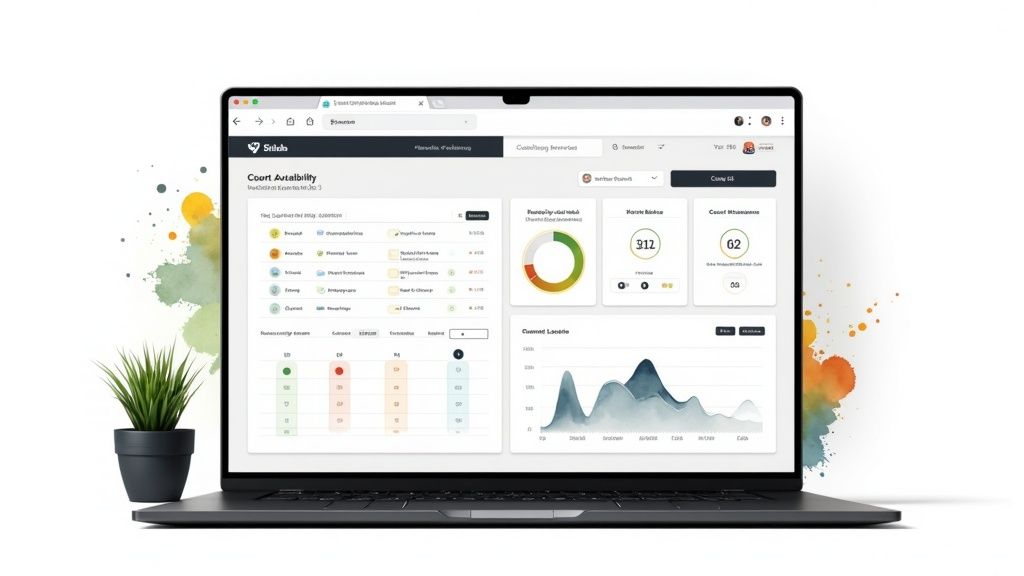
Alright, you’ve got your club's needs mapped out. Now comes the fun part: figuring out which software features will actually deliver. It’s easy to get lost in marketing buzzwords, so let's cut through the noise and focus on the functions that genuinely impact your efficiency, keep your members happy, and boost your bottom line.
The heart of any tennis court booking software is the calendar, of course. But a simple online schedule is just table stakes. The best systems weave this calendar into a complete operational ecosystem for your entire club.
Real-Time Booking And Court Management
The absolute, non-negotiable foundation is a booking engine that works in real time across every device. This means when a member books a court on their phone at 10 PM, that slot is instantly gone on your front desk computer, another member's laptop, and everywhere else.
This immediate sync completely kills the dreaded double-booking nightmare that every manager using a paper system knows all too well. It gives members the freedom they expect and gets your staff out of the business of being schedule gatekeepers.
When you're looking at scheduling, make sure you see:
- Access on Any Device: The booking experience has to be just as smooth on a tiny phone screen as it is on a big desktop monitor.
- Custom Booking Rules: Can you easily set different booking windows for gold-tier members versus standard ones? What about blocking out courts for a weekend tournament or weekly maintenance? You need that control.
- Automated Waitlists: When a prime-time court is full, the system should handle the waitlist for you. If someone cancels, it should automatically ping the next person in line. No more manual phone calls.
Seamless Payment Processing And Financial Tools
Let’s be honest: chasing down members for court fees and late dues is a massive waste of time. An integrated payment system isn't a "nice-to-have"—it's a must for healthy cash flow and a professional member experience.
The software should make paying for court time, lessons, or tournament entries a simple part of the booking process. It should also effortlessly handle common headaches like splitting court fees between four players.
Even with the shift to digital, direct club bookings are still a huge piece of the pie, valued at around $7.44 billion. This tells us you need a system that can handle both online and walk-in payments without missing a beat. Good tennis court booking software unites these streams into one clean financial dashboard.
A truly integrated payment system does more than just collect money. It provides a clear financial picture of your club, showing you which services are most profitable and where your revenue is coming from at a glance.
Robust Member And Coach Management
Your members are the lifeblood of your club, and your software should treat them that way. Think of the member management module as your club’s central nervous system. It holds everything in one secure spot: contact info, membership levels, booking history, and payment status.
This centralization is what allows for truly targeted communication. Imagine being able to email all your "Peak Time Players" about a new weekday morning clinic. Or sending a renewal reminder only to members whose accounts expire next month. You just can't get that personal with a bunch of scattered spreadsheets.
For your pros, the system should empower them to manage their own time. A dedicated coach module lets them set their own schedules, which then syncs directly with the court calendar. Members can see who's free and book a lesson on the spot—a massive upgrade from the old back-and-forth phone tag. If you want to dig deeper, exploring some smart booking systems features that matter can give you a clearer picture of what's possible.
Communication And Reporting Tools
How do you tell everyone a court is closed for repairs? Or get the word out about the upcoming club championship? Integrated tools like push notifications and targeted emails are infinitely more effective than a note tacked to a corkboard. These features keep your community engaged, informed, and feeling connected.
Finally, don't sleep on the analytics. The right software doesn't just process transactions; it organizes that data into reports that help you make smarter business decisions. When evaluating vendors, it's critical to check for robust tools, like integrating reservation functionalities, which are crucial for optimizing how you manage your court availability.
Good reports can instantly show you:
- Court Utilization Rates: Pinpoint your busiest and quietest times to run promotions or adjust pricing.
- Member Activity: See who your most active members are and, just as importantly, spot those who might be at risk of not renewing.
- Revenue Breakdowns: Understand exactly where your money is coming from—court fees, lessons, events, or pro shop sales.
These are the features that elevate your software from a simple scheduling tool into a strategic asset that actually drives growth.
Essential vs. Advanced Software Features
To help you prioritize, let's break down the features into two camps: the absolute essentials you need to run your club today, and the more advanced tools that will help you grow and stand out tomorrow.
| Feature Category | Essential Functionality (Must-Have) | Advanced Functionality (Nice-to-Have for Growth) |
|---|---|---|
| Booking & Scheduling | Real-time calendar, mobile access, basic rule setting (e.g., booking windows). | Automated waitlists, recurring bookings, multi-court/multi-day event scheduling. |
| Payments | Integrated online payments for bookings, membership dues processing. | Point-of-Sale (POS) for pro shop, automated invoicing, fee splitting for groups. |
| Member Management | Central member database, membership tier management, booking history. | Automated renewal reminders, member self-service portal, loyalty programs. |
| Communication | Basic email notifications (booking confirmations, cancellations). | Targeted email campaigns, push notifications, integrated SMS alerts. |
| Reporting | Basic reports on revenue and court bookings. | Detailed court utilization analytics, member churn prediction, pro performance reports. |
| Operations | Coach schedule management, basic court maintenance blocking. | White-label mobile app, league and tournament management modules, access control integration. |
Think of the "Essential" column as your foundation. Without these, you'll constantly be fighting fires. The "Advanced" column is where you start to really pull ahead of the competition, offering a superior experience for both members and staff.
How to Choose the Right Software Partner
Once you have your requirements list nailed down, it’s time to start looking at software providers. But I want you to reframe this process. You’re not just buying software; you’re choosing a long-term partner for your club.
The right partner will feel like a natural extension of your team, someone who gets your business and is invested in your success. The wrong one? That’s a recipe for years of headaches, frustration, and wasted potential. This decision goes way beyond the features on a checklist—it’s about the people and the service powering the technology.
Your main job here is to see past the slick sales pitch. You need to get a feel for the day-to-day reality of living with this system. Is the interface genuinely easy to use for everyone, from your tech-savvy younger members to your senior players who might be less comfortable with new apps? Will the system grow with you when you add those new pickleball courts next year? These are the questions that truly matter.
Look for a True Partnership
Your relationship with a software vendor can't end the minute the contract is signed. The best companies I’ve worked with operate as true partners. That means you need to scrutinize their support structure just as carefully as you do their feature list.
Think about it: when a critical issue pops up on a packed Saturday morning, how are you going to get help?
- Support Channels: Do they offer real-time phone support and live chat, or are you stuck submitting a ticket and hoping for a response?
- Hours of Operation: Is their team available when you’re busiest, including evenings and weekends?
- Onboarding and Training: What’s their plan to get you and your staff comfortable? A great partner provides hands-on training, not just a link to a generic help article.
A vendor’s true colors often show in their support model. If getting help seems like a chore before you’ve even paid them, consider it a massive red flag.
Prioritize the User Experience
Look, the most feature-packed software on the planet is worthless if people hate using it. You have to evaluate the user experience (UX) from two critical angles: your staff and your members. A system that’s a dream for your front desk but a nightmare for your members is a failure. The reverse is also true.
When you’re in a demo, don’t just sit back and watch the salesperson click around. Insist on getting a trial account. Try to perform a few common tasks without any hand-holding.
For Your Staff:
- Can you book a court for a member over the phone in under 30 seconds? Seriously, time it.
- How intuitive is it to block out courts for a tournament or scheduled maintenance?
- Can you pull up a member's payment history or booking log in just a couple of clicks?
For Your Members:
- From the home screen, how many taps does it take to book a court?
- Is the mobile app just as clean and functional as the desktop website?
- Can they easily find their upcoming reservations and see past activity?
A clunky or confusing process is a non-starter. Your members will just give up and go back to calling the front desk, defeating the whole purpose of the investment.
Dig Deep During the Demo
A sales demo is pure theater—it’s designed to show you a perfect-world version of the software. Your job is to poke holes in it. Come prepared with your requirements document and don't be shy about asking very specific, tough questions.
Bring your club’s real-world scenarios to the table. For instance, say something like: "We have a 'Family' membership where parents and two kids can book one court per day, but the kids are restricted from booking after 6 PM on weekdays. Show me exactly how I would set up that specific rule in your system."
Vague questions get you vague, polished answers. Specific scenarios force the salesperson to show you the system’s true flexibility (or its limitations). If giving your club a unique, branded feel is important, this is also the perfect time to ask about customization. You can get a better sense of what’s possible by understanding what white-label software is and how it allows a provider to tailor their platform to your brand.
Finally, and this is crucial, always ask for references. And then actually call them. Find a club manager at a facility that’s similar to yours and ask for their honest opinion. Ask about the software's reliability, how responsive the support team really is, and what unexpected challenges they hit during setup. That candid, peer-to-peer feedback is pure gold—it’s often the most valuable intel you’ll get.
Planning a Smooth Launch and Data Migration
You’ve picked your new tennis court booking software. That’s a huge win, but the job isn't done until your members are using it seamlessly. A successful rollout isn’t about flipping a switch and hoping for the best; it’s a carefully planned process that minimizes chaos and gets everyone on board from day one. This is where all that upfront planning really starts to shine.
The whole thing kicks off long before you announce a launch date, starting with the most critical—and most underestimated—task: data migration. Think of it like moving houses. You don't just throw everything in boxes. You sort, you clean, you label, and you make sure nothing valuable gets lost or broken along the way.
Preparing Your Data for the Big Move
Your member data is the lifeblood of your club. It doesn't matter if it’s currently living in old software, a messy collection of spreadsheets, or even dusty paper records. Before you can import it into your shiny new system, it has to be pristine. The old saying "garbage in, garbage out" has never been more true.
First, get all your member information exported into a universal format, like a CSV file. Then, it's time to roll up your sleeves and get cleaning.
- Scrub for Duplicates: Every club has them. Find and merge those duplicate member profiles that have snuck in over the years.
- Standardize Everything: Consistency is key. Is it "Street" or "St."? Are all the phone numbers formatted the same way? Clean, uniform data helps the new software do its job properly.
- Archive Old Records: You probably don't need to import every member who hasn't played in the last five years. Decide on a cutoff for inactive members, but make sure you have a way to keep their history archived just in case.
Think of data migration as laying the foundation for your new digital clubhouse. A clean, organized foundation supports a stable and reliable structure. A messy one will cause cracks to appear right when you can least afford them.
This visual shows how you move from the evaluation stage right into this critical implementation phase.
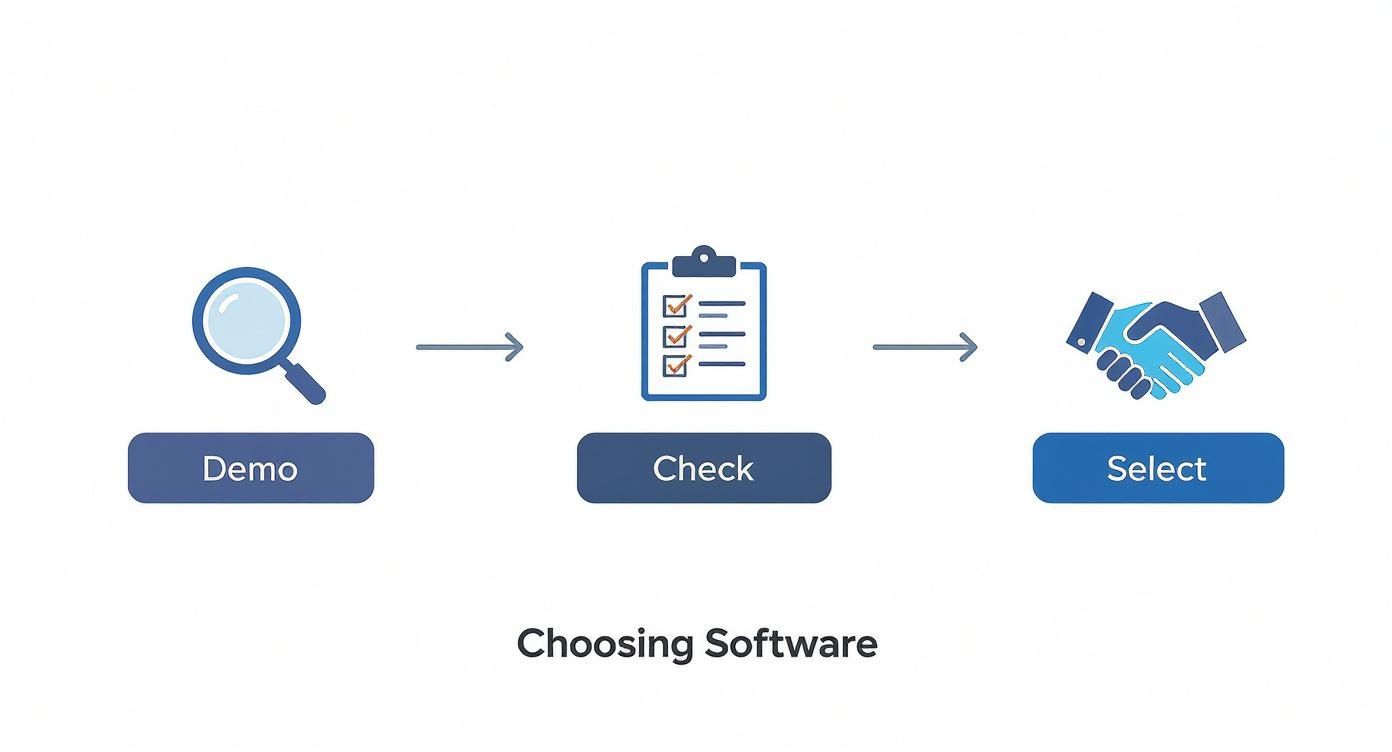
As the graphic shows, picking a vendor is just the start of the partnership. The real work begins with migration and setup.
Configuring Your New Digital Clubhouse
With your data cleaned up, you can start building your club's operational rules inside the new tennis court booking software. This is the part where you take all those requirements you defined earlier and turn them into actual system settings. This is a team effort—work closely with your software provider’s onboarding specialist to get everything just right.
- Court and Resource Setup: Define every single court, its surface type, and any special features like lighting that might affect booking rules or pricing.
- Membership Tiers: Carefully recreate your exact membership structure. Whether you have a "Junior" plan or a "Family Gold" package, make sure every privilege and booking window is assigned correctly.
- Pricing and Rules: This is your chance to automate. Set up all your pricing, guest fee rules, and cancellation policies so the system can handle them without anyone needing to lift a finger.
The Power of a Phased Rollout
Whatever you do, don't launch to everyone at once. The secret to a painless transition is a phased rollout.
Start small. Pick a pilot group of trusted staff and a handful of your most tech-savvy, loyal members. Let them be your guinea pigs. Give them access for a week or two and ask for their honest, unfiltered feedback.
This approach is your final quality check. Your pilot group will find the little bugs, the confusing buttons, and the settings you overlooked. Trust me, they always do. Fixing those issues for a group of ten is a breeze compared to fielding complaints from hundreds of frustrated members after a botched launch. It’s a controlled test run that builds confidence and ensures that when you finally go live, the experience is polished and professional from the get-go.
Driving Adoption and Maximizing Your ROI
Getting your new tennis court booking software up and running is a huge step, but let's be honest—the real win isn't the launch day. It's what happens after. The true return on your investment kicks in when your staff and members actually use the system and love it, making it a natural part of your club's daily rhythm. This doesn't just happen on its own; it takes a smart, deliberate plan focused on great communication.
https://www.youtube.com/embed/TfOcbqjpRS8
Think of your staff as your internal champions. If they're confident and genuinely enthusiastic about the new platform, that feeling will be contagious. Don't just give them a bland feature tour. Explain the why behind the change. Show them how this new tool gets rid of their most annoying, repetitive tasks, freeing them up to do what they do best: engaging with members.
Empowering Your Team From Day One
A single training session is never enough. You need to build muscle memory and genuine confidence. The best way to do that? Let them play. Set up a "sandbox" or a test version of the software where they can click every button and try every feature without any fear of breaking something.
A solid onboarding plan usually includes a few key things:
- Role-Specific Training: Your front desk team needs to master different skills than your club pros. Create quick, targeted training modules for the tasks each person will handle most.
- Cheat Sheets Are Your Friend: Seriously. Simple, one-page guides for common tasks—like booking a court for a member over the phone or processing a lesson payment—are lifesavers.
- Run a "Dry Run" Week: Before you unleash the software on your members, have your team use it for all internal bookings for a full week. They'll work out the kinks and feel like pros by the time it goes live.
Engaging Your Members for a Flawless Launch
When it comes to your members, your message needs to be crystal clear and focused entirely on the benefits for them. Forget the technical jargon. Talk about what they gain: no more busy signals when they call, the freedom to book a court 24/7 from their phone, and a dead-simple way to manage their club life.
Start spreading the word early and keep it going. Use every channel you have—emails, posters in the clubhouse, social media updates. Make it impossible for them to miss the news.
You might even consider hosting a small launch event or a "tech tutorial" morning with coffee and snacks. A short, friendly video showing someone booking a court in under 60 seconds can do wonders to calm any nerves about learning a new system.
The goal here is to make this feel like an exciting upgrade, not a chore. If you celebrate the launch and hammer home the advantages, you'll turn your members into your biggest advocates.
Finally, let the numbers do the talking. Use the software's built-in analytics to track court usage and revenue from before and after you made the switch. The broader market for tennis services and equipment is expected to grow by over $2.14 billion in the next few years, largely because of technology that makes clubs like yours run better. You can explore more insights into the growing tennis market on technavio.com. Sharing this kind of positive data with your board or owners is the ultimate proof that your investment was a smart one. Armed with real data, you can make better decisions and even use a revenue calculator to project future earnings now that your operations are fully optimized.
Still on the Fence? Let's Talk Through Common Questions
Even after you've done your homework and narrowed down the options, it's totally normal to have a few last-minute questions before signing on the dotted line. I’ve seen hundreds of club managers go through this process, and the same handful of concerns always seem to pop up.
Let's clear the air on some of the most common ones.
So, What's This Going to Cost Me?
This is always the first question, and for good reason. The truth is, pricing for court booking software is all over the map. It usually scales with the size of your club—how many courts you have and the number of members you serve.
Most platforms use a tiered subscription model.
- For a smaller club just needing the basics, you might find a solid plan for $50 to $100 per month.
- Larger facilities that need the whole nine yards—think advanced marketing tools and a slick, custom-branded app for members—are looking at several hundred dollars a month.
My advice: Get a detailed quote and ask them to break it down. Specifically, you want to know if there are any one-time setup or data migration fees. Don't let those surprise you later.
But Can It Handle Our Club's Quirky Rules?
Every club has its own unique way of doing things, from special membership tiers to specific guest policies. A big worry is whether a new system will force you to change what’s already working.
The short answer? A good system won't. In fact, it should bend to your rules, not the other way around.
This is a core feature, not a nice-to-have. You should be able to set up as many membership types as you need—"Individual," "Family," "Junior," you name it—and give each one its own booking privileges, court fees, and reservation windows. The same goes for guests. The platform needs to let you collect guest fees right at booking and cap how many times a guest can play.
The right software should feel like it was built just for you, molding itself to the operational rules that keep your members happy.
What's the Real Story on Switching From Our Old System?
Finally, the big one: the migration. Managers often dread the thought of moving years of data from an old system (or worse, a collection of spreadsheets). How painful is it really going to be?
It all comes down to two things: the state of your current data and how much help your new software partner is willing to give.
If you’re moving off something like Excel, the main job is getting your member lists and maybe some booking history into a standard CSV file. Any software vendor worth their salt will offer data migration assistance as part of their standard onboarding. Make this a deal-breaker question in your final calls. You need to know exactly how hands-on they'll be to make sure the switch is as smooth and painless as possible.
Ready to see how a platform designed for growth can elevate your club's operations? Book & Go delivers a fully branded mobile app and the powerful management tools you need to create an experience your members will love. Let’s talk about how we can tailor our solution to your club's unique needs. Find out more at https://www.bookandgo.app/en.