An effective app-based pickleball schedule is the only real solution to the chaos of manual booking. It completely transforms how clubs manage court time and, more importantly, how members feel about playing at your facility. It takes those outdated spreadsheets and endless phone calls and replaces them with a smooth, automated system that kills double bookings and frees up your staff's time—instantly.
Why Manual Scheduling Just Can't Keep Up with Pickleball
If your club is still tacking a sign-up sheet to a corkboard or wrestling with a clunky spreadsheet to manage court time, you’re feeling the pain. I see it all the time. The explosive growth of pickleball has pushed these old-school methods past their breaking point, creating daily headaches for both your staff and your members.
This isn't just a minor inconvenience; it's a huge operational bottleneck that’s costing you time, money, and maybe even your sanity.
The core problem is simple: manual systems weren't built for this kind of demand. Every phone call to book a court is an interruption. Every name erased on a whiteboard is a potential conflict waiting to happen. These little inefficiencies add up fast, leading to the same headaches I hear about from club managers everywhere.
The Daily Grind of Outdated Systems
Just picture a typical Saturday morning. Your phone is ringing off the hook with members trying to grab a court. While you're on one call, another member leaves a voicemail, and a third sends a text. At the same time, someone at the front desk is trying to pencil in a group for what they think is the last available court.
The potential for error is massive. This mess leads directly to the classics:
- Double Bookings: Two groups show up ready to play, only to find they're booked for the same court. It’s frustrating for them and a nightmare for your staff to sort out.
- Constant Interruptions: Your team can't focus on high-value tasks—like member engagement or programming—because they’re stuck playing telephone operator.
- Member Frustration: Players have no way to see real-time availability. They’re forced to call or just show up, often finding out that no courts are free.
This friction doesn't just create a bad experience. It actively limits your ability to maximize court usage. An empty court is lost revenue, plain and simple. And a frustrated member is always a retention risk.
How the Pickleball Boom Complicates Everything
This whole scheduling challenge is being amplified by the sport's incredible rise. Pickleball participation in the United States has nearly tripled in just the last three years. Recent reports show that nearly 50 million U.S. adults have played the game.
This surge, especially among younger players who expect a digital experience, means more people are competing for the same limited court space. You can dig into the specifics of this massive growth in these detailed pickleball statistics.
For modern clubs, a dedicated app for your pickleball schedule is no longer a luxury—it's essential infrastructure for survival and growth.
Before diving into how to set up a digital system, let's do a quick side-by-side. The difference between running your club the old way versus with a dedicated app is night and day.
Manual vs App-Based Scheduling Comparison
| Feature | Manual Scheduling (Phone/Spreadsheet) | App-Based Scheduling |
|---|---|---|
| Booking Process | Staff-dependent, high-friction | 24/7 self-service for members |
| Court Availability | Opaque; requires a phone call | Real-time, visible to everyone |
| Double Bookings | Common and disruptive | Eliminated by the system |
| Staff Time | Hours spent on calls and updates | Minimal; focused on member experience |
| Payments | Manual, in-person transactions | Automated, integrated at booking |
| Data & Reporting | None or difficult to compile | Instant access to utilization reports |
| Member Experience | Inconvenient and frustrating | Seamless, modern, and empowering |
The table really tells the whole story. One path leads to operational drag and constant headaches, while the other opens the door to efficiency, higher revenue, and happier members. The choice is pretty clear.
Building Your Digital Court Management Foundation
Switching your pickleball schedule over to an app isn't just about getting new software—it's about creating a digital twin of your facility. This is the bedrock. Get this foundational setup right, and you'll sidestep the vast majority of scheduling headaches down the road.
Your first move is to map out your courts digitally. This goes way beyond just numbering them Court 1, Court 2, and so on. Think about what makes each court unique. Does Court 4 have stadium lighting for those late-night games? Is Court 1 your go-to "championship" court with a premium surface? Getting these specific details into the app is a game-changer.
When you capture this level of detail, members can filter and book courts based on what they actually need, which creates a fantastic user experience right from the get-go.
This infographic really nails the transition, showing the shift from the chaos of manual scheduling to the clean, simple efficiency of an app.
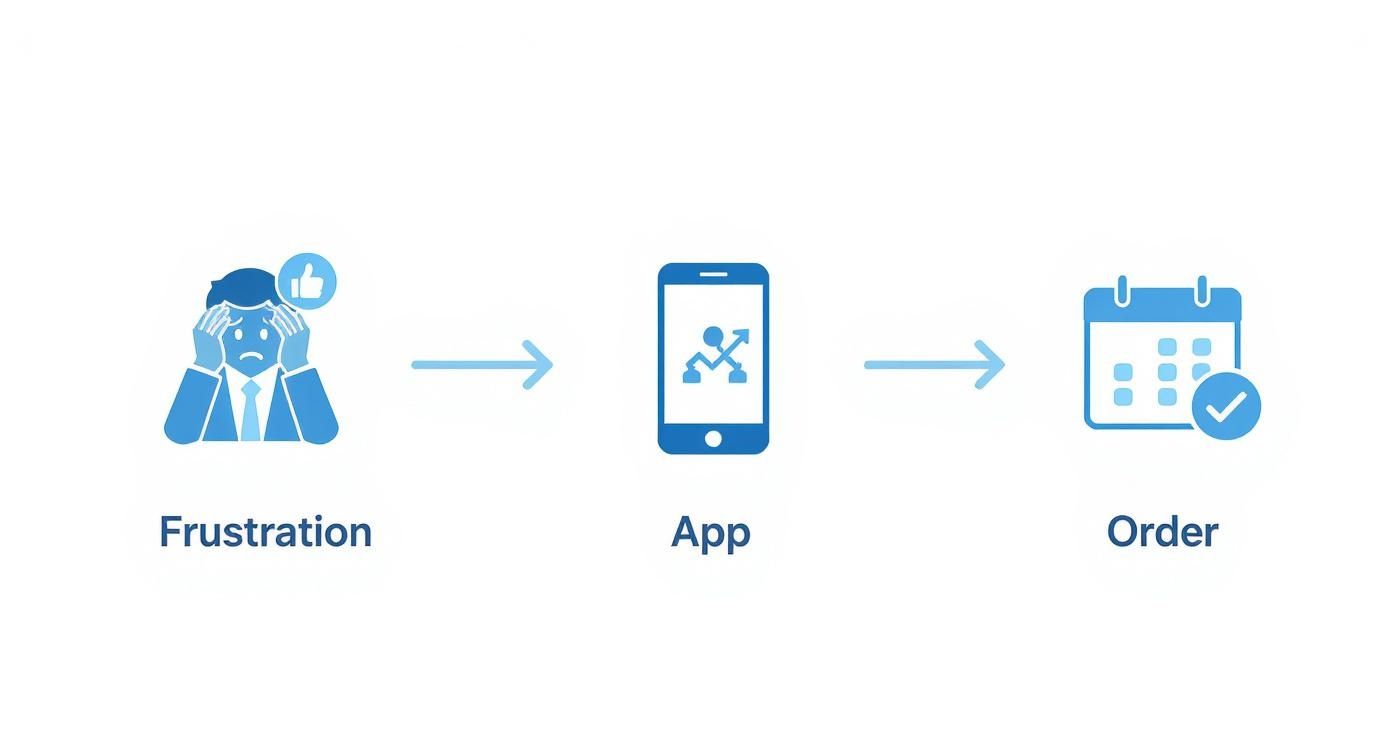
You can see how a dedicated app directly tackles the frustration and disorganization that come with doing things the old-fashioned way.
Establishing Your Core Booking Rules
Once your courts are in the system, it's time to lay down the law—the digital policies that keep everything fair and prevent anyone from gaming the system. The core of great court management is a solid digital framework. Just like hotels streamline their operations, implementing a robust reservation system can completely change how you manage your pickleball courts.
Start by defining the key rules of play:
- Booking Windows: How far out can members book a court? A 7-day rolling window is a popular and effective place to start.
- Time Limits: Are bookings for 60 or 90 minutes? You might even set different limits for peak and off-peak hours to maximize flow.
- Booking Frequency: How many reservations can one person hold at a time? This is key to stopping a few players from hogging all the best court times.
- Cancellation Policies: Be firm but fair. A clear cutoff, like 24 hours in advance, gives other players a chance to grab last-minute openings.
A well-configured booking system does more than just take reservations. It actively manages member expectations and maximizes court time by automatically enforcing your club's policies.
While many of the examples and principles in our guide on tennis court reservation software are directly applicable to pickleball, the key is customization. Take the time to build this digital foundation properly. Honestly, it's the single most important step in creating a pickleball schedule that works for you and your members.
01 / An open slot at 19:00. Players see it live in your club’s app.
Automating Your Recurring Pickleball Programs

This is where you really start to get your time back. Once your digital court foundation and basic booking rules are in place, the next big win is automating the recurring programs that are the lifeblood of your club. These are the consistent, predictable events that keep members coming back and your revenue stream flowing.
Instead of manually blocking out courts week after week, an app pickleball schedule lets you set up your core offerings once and then just let them run. Think about it—no more double-bookings, no more forgotten reservations. This isn’t about saving a few minutes; it’s about erasing hours of tedious admin work and cutting out the risk of human error.
Imagine your "Tuesday Morning Drills" clinic or the "Thursday Night Ladder League." In just a few clicks, you can lock in the same four courts every week for the entire season. The system handles it all, automatically preventing any scheduling conflicts with one-off member bookings.
Setting Up Your Core Programs
So, where to begin? Start by identifying your most popular and consistent programs. These are the low-hanging fruit for automation and will give you the biggest, most immediate return on your time.
- Weekly Leagues: Reserve specific courts at set times each week for all your league play. The app should handle the recurring block automatically, guaranteeing those courts are always ready for your league members.
- Group Clinics: Get your coaches' weekly clinics for various skill levels on the calendar. You can block out the necessary courts and tie the schedule directly to coach availability and member sign-ups.
- Reserved Group Play: Many clubs have those dedicated times for specific groups, like "Advanced Seniors Play" on Monday mornings. Automating these reservations respects those long-standing traditions without any of the manual hassle.
This level of organization is becoming non-negotiable as the sport’s demand continues to explode. Pickleball has grown into a global sensation, with a market valued at around $1.8 billion and projected to climb past $9 billion in the next decade. That incredible growth, detailed in recent market analyses, means more players are fighting for court time, making smart scheduling absolutely essential. You can learn more about pickleball's global expansion here.
Balancing Automation with Open Play
A common worry I hear from managers is that automating programs will lock out casual players who just want to book a court for an hour. The trick is to strike the right balance to keep all your members happy. A good scheduling app gives you the visibility to do just that.
Pro Tip: Don't automate every single court during prime time. I always recommend leaving a percentage of your courts—maybe 25-40% during peak hours—available for general open play. This ensures that members who aren't in a league or clinic still feel like they have fair access.
For instance, if you have eight courts, you might dedicate four to your evening league from 6-8 PM, but leave the other four open for members to book individually. This hybrid approach maximizes court usage while catering to everyone. The visual calendar in the app makes this balance crystal clear to both your staff and your players, preventing frustration and creating a system that feels fair to the whole community.
Integrating Lessons, Tournaments, and Events
A truly great pickleball schedule in your app is more than just a grid for booking courts—it’s a powerful revenue engine waiting to be fired up. Once you've got your regular programs running smoothly, the real magic happens when you integrate high-value activities like private lessons, group clinics, and big events directly into that digital ecosystem.
This is how you transform your app from a simple booking tool into the central hub for everything happening at your club.
The whole point is to eliminate the administrative headache for both your staff and your members. Picture this: a player just finished a beginner clinic, they're feeling fired up about their progress, and they pull out their phone to instantly book a private lesson with their favorite coach for next week. That seamless experience is what keeps people engaged and is exactly how you boost your secondary revenue streams.
Streamlining Coach and Lesson Scheduling
Let's be honest, managing coaches' schedules can be a chaotic mess of texts, calls, and messy spreadsheets. A dedicated app brings order to the chaos by putting all coach availability in one place and letting members book lessons themselves. This self-service model is a massive win for everyone.
Get started by having each coach plug their availability directly into the app. This creates a master calendar that members can see in real-time.
- Assign Specific Courts: Block off certain courts for instruction during peak teaching times. This simple step prevents a lesson from accidentally getting booked over open play.
- Automate Payments: This is a big one. Require members to pay for their lesson when they book it. It virtually eliminates no-shows and saves your staff from the awkward task of chasing down payments.
- Track Performance: Use the app’s data to see which coaches are booking the most hours and which clinics are selling out. This is gold when it comes to planning future programs.
A system like this frees up your coaches to do what they do best: coach. Not play phone tag.
By integrating lesson bookings directly into your main schedule, you create a frictionless path for members to invest more in their game—and in your club. It turns a logistical headache into a smooth, revenue-generating machine.
Mastering Tournaments and Special Events
Tournaments, social mixers, and special clinics are fantastic for building community and are often huge revenue drivers. But man, the logistics can be a nightmare. Using your app simplifies the entire process, from the initial announcement to the final match.
For a weekend tournament, you can block out all the courts you need for the entire event with just a few clicks.
That single action instantly pulls those courts from the general booking pool, so you don't have to worry about double-bookings or other conflicts. From there, members can register and pay for their spot right in the app, which automatically builds your participant roster for you.
Organizing the competition itself becomes way easier, too. If you're new to running a tournament, figuring out how to structure the gameplay is critical. You can get a great walkthrough by checking out our guide on how to create a tournament bracket. Using your app to manage the schedule and push out updates keeps every player in the loop, ensuring your event runs like a well-oiled machine from start to finish.
Using Data to Optimize Court Revenue

Once your automated programs are running and members are booking through the app, your app pickleball schedule starts churning out its most valuable asset: data. This is the moment you shift from just managing courts to strategically squeezing every last drop of revenue from them. It’s time to stop guessing and start making truly informed decisions.
Think of your app's analytics dashboard as a goldmine. It holds the key to understanding the real rhythm and pulse of your club. By digging into booking patterns and court utilization reports, you can finally see your actual peak and off-peak hours, backed by hard numbers instead of just a gut feeling.
Identifying Your True Peak Hours
First things first, you need to pinpoint exactly when your courts are in the highest demand. Don't just assume it's "weeknights and weekend mornings." I’ve seen clubs get this wrong all the time, and the data often reveals some big surprises. You might discover that weekday lunch hours are an untapped goldmine or that those early bird slots from 6 AM to 8 AM are consistently booked solid.
Look for these specific trends in your analytics:
- Hourly Utilization: Which hours of the day have the highest booking percentages?
- Day-of-Week Demand: Is Saturday afternoon actually busier than Sunday morning? The data will tell you.
- Member Segments: Are your premium members gobbling up all the prime-time slots?
This is the intel you need to build a smarter pricing strategy. For those who really want to get into the weeds, exploring resources on effective data-driven decision making can provide some fantastic perspectives.
Implementing Data-Driven Pricing
With a crystal-clear picture of court demand, you can introduce dynamic pricing to boost your bottom line without alienating members. This isn't about price gouging—it's about aligning cost with demand, a standard practice in pretty much every successful service industry.
Here’s a simple, tiered pricing model to consider:
- Prime Time: Your most popular slots (say, weeknights 6-9 PM) get a modest price increase.
- Standard Time: Regular hours with steady traffic keep your base court fee.
- Off-Peak Hours: The quieter periods (like weekday mid-afternoons) get a discount to encourage more bookings.
This approach does two things beautifully. It increases revenue from your most valuable time slots and also incentivizes players to fill the courts during those historically slow periods. You can even run the numbers yourself—our free pickleball court revenue calculator is a great tool for projecting your potential earnings.
By letting data guide your pricing, you transform your schedule from a simple booking tool into a dynamic revenue management system. This strategy ensures you're capturing the maximum value for every court, every single hour.
The commercial outlook for pickleball is just incredible right now. The market valuation has shot past $1.47 billion and is projected to grow at a compound annual rate of around 11.3% over the next decade. That growth means a massive demand for courts and organized play. Smart scheduling is how you capture a piece of that ever-expanding pie.
Push notifications are another powerful tool in your arsenal. See a court open up unexpectedly during prime time? Send a targeted alert to members who frequently play around then. Have a few spots left in a weekend clinic? A last-minute push notification with a small discount can be the difference between a full house and a financial loss.
Answering Your Top Questions About a New Scheduling App
Switching to a modern scheduling system is a big move. I get it. It’s totally normal to have questions. Most club managers I talk to are excited about the upside but a little nervous about the transition itself. They wonder about pushback from members, the headache of moving from an old system, and frankly, how to pick the right software in the first place.
Let's walk through these common hurdles together. The whole point is to make this a smooth, successful rollout for everyone—from your front desk team to your least tech-savvy members.
Will Our Members Actually Use It?
This is always the first question, and it's a good one. The secret to getting members on board is picking an app with a dead-simple booking process. If it takes more than three or four taps to book a court, you’ve already lost. The best platforms are built around the user, not the other way around.
To make the transition stick, it all comes down to communication.
- Give a Heads-Up: Start talking about the new system weeks before you launch. Plant the seed early.
- Sell the Benefits: Don't just announce a change; announce an upgrade. This gives them 24/7 access to book courts, see who's playing, and sign up for events without making a single phone call.
- Show, Don't Just Tell: Create a few short video clips or a simple one-page PDF showing exactly how to book a court. Visuals make all the difference.
Once members realize the new app pickleball schedule saves them time and cuts out the frustration of waiting for a call back, they'll wonder how they ever lived without it.
How Do We Ditch Our Old System?
The thought of migrating from a chaotic mess of spreadsheets or a clunky old calendar can feel overwhelming. But honestly, it’s more straightforward than you’d think. Any good software provider will have a dedicated team to hold your hand through the process. You’re not just buying a tool; you're getting a partner who has done this hundreds of times.
Typically, the process involves pulling your existing member data and court info, which then gets bulk-uploaded into the new platform. The single most important thing you can do is clean up your data before the import. This is the perfect chance to update old phone numbers, fix misspelled names, and get rid of duplicate accounts. You get to start with a perfectly clean slate.
Don’t look at this as just a technical task. Think of it as a hard reset for your club's operations—a chance to set a new, higher standard for how you run things and serve your members.
With the right partner, they do most of the heavy lifting. Your main job is to keep your members in the loop and get your staff comfortable with the new dashboard. And that brings us to the last critical piece: getting your team trained up.
Ready to see how a dedicated scheduling app can transform your club's operations and boost revenue? At Book & Go, we provide a fully branded, easy-to-use platform that your members will love and your staff can manage with ease. Learn more and schedule your free demo with Book & Go today.