Getting your club’s badminton court bookings online is simpler than you might think. The first step is to lay a solid foundation by defining your court types, setting your operating hours, and blocking out any recurring maintenance times in your new digital system. Nail this part, and you’ll sidestep double bookings and kill a lot of administrative headaches right from the get-go.
Building Your Digital Booking Foundation
Let’s be honest: moving away from phone calls and scribbled-down paper schedules is probably the single most impactful change you can make for your club. It’s the difference between constantly putting out fires—like booking clashes and member complaints—and actively growing your community.
The goal here is to build a reliable digital backbone that handles all the tedious work for you. This frees you up to focus on what really matters: the player experience. And it all starts with a few deliberate setup steps.
Modern booking platforms have completely changed the game, turning clunky, manual processes into slick, efficient online systems. These web-based tools give your members 24/7 access to see real-time availability and get instant confirmations. This immediately eliminates the delays and mix-ups that are all too common with phone calls or in-person requests.
Defining Your Court and Schedule Rules
Your first real task is to translate your physical facility into a digital format. This isn't just about listing "Court 1, Court 2, Court 3." It's about defining the unique characteristics and availability of each court with absolute precision.
Start by categorizing them. Do you have dedicated singles courts? Doubles courts? Maybe a few multi-purpose surfaces that can be used for training? Differentiating them in your system prevents players from booking the wrong type of court and sets clear expectations from the start. For instance, you could label one as a "Competition Court" and give it different booking rules or a premium price compared to a "Standard Court."
Next, lock in your core operating hours. Be specific. If you open at 7 AM on weekdays but 9 AM on weekends, your system needs to reflect that. It's also super important to block out any recurring times for maintenance, deep cleaning, or those weekly coaching clinics. This proactively removes those slots from public view, stopping any accidental bookings before they happen.
This journey from manual, time-sucking methods to the instant, automated systems we have today is a game-changer. The real win is how technology smooths out the friction for both your staff and your players.
To put it into perspective, here’s how the old way stacks up against a modern digital approach.
Manual vs Digital Booking System Comparison
| Feature | Manual System (Phone/Paper) | Digital System (Online Software) |
|---|---|---|
| Availability | Staff-dependent; limited to business hours | 24/7 access for members from any device |
| Booking Speed | Slow; involves phone calls, voicemails, waiting | Instant; real-time confirmations |
| Accuracy | Prone to human error, double bookings, lost notes | Automated and synchronized; eliminates conflicts |
| Payments | In-person cash/card; manual tracking | Secure online payments; automated invoicing |
| Member Experience | Inconvenient; requires effort from the member | Seamless and user-friendly; empowers members |
| Admin Workload | High; constant interruptions and manual entry | Minimal; system manages bookings automatically |
The difference is night and day. A digital system doesn't just make things faster; it fundamentally changes how your club operates for the better.
Laying The Technical Groundwork
Once your rules are mapped out, your focus can shift to the software itself. A good system should have a clean, simple interface that makes this initial setup feel easy. For those curious about the mechanics behind these platforms, a deep dive into custom web application development can offer some great context on how they're built from the ground up.
The best systems don't just take bookings; they enforce your club's rules automatically. Your initial setup is where you teach the software how your facility operates, ensuring it works for you, not against you.
This digital foundation is so much more than a convenience. It's the engine that drives court utilization, boosts revenue, and keeps your members happy. By getting the setup right from day one, you create a smooth, professional experience that players will genuinely appreciate.
To see what specific features can make the biggest impact, check out our guide on smart booking systems features that matter.
Crafting a Smart Pricing and Membership Strategy
A simple, flat hourly rate for your badminton courts is easy, but let's be honest—it's probably costing you money. A more thoughtful pricing structure can do more than just boost revenue; it can build loyalty and fill those courts during quiet hours you thought were a lost cause.
The trick is to ditch the one-size-fits-all approach. By getting a bit more dynamic, you can align your pricing with actual player demand. This means you can (and should!) charge a premium for those high-demand Saturday morning slots, while offering a tempting discount for a Tuesday afternoon. Suddenly, underused court time starts pulling its weight.
This decision tree gives a good visual of that initial fork in the road: stick with old-school manual methods, or embrace a digital system that makes these smarter strategies not just possible, but easy.
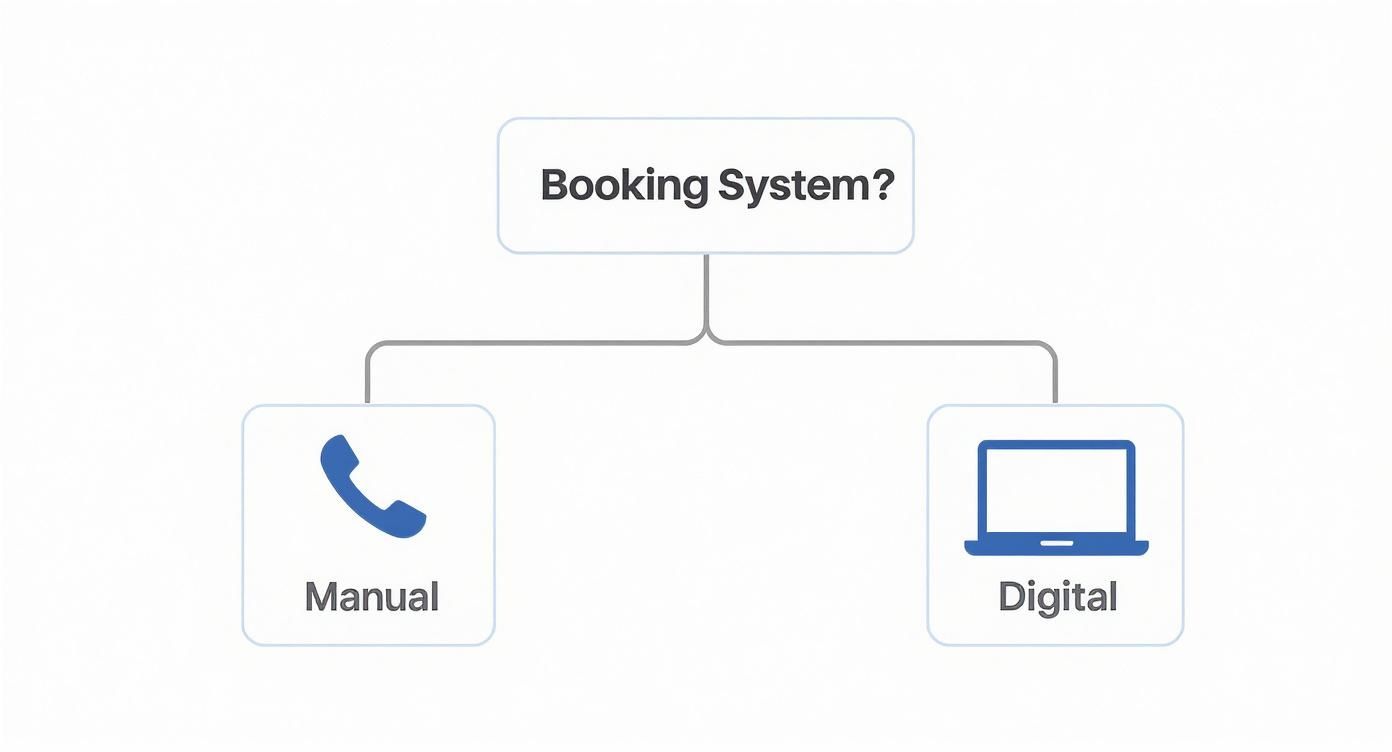
Going digital is what really unlocks the ability to build out sophisticated pricing and membership tiers—the kind of stuff that’s a nightmare to manage on a spreadsheet.
Tiers That Turn Players Into Fans
One of the most powerful moves you can make is introducing tiered memberships. Don't just stop at a "member vs. non-member" discount. Instead, design distinct levels with escalating value. It's a natural way to encourage players to get more invested in your club.
A three-tier model works wonders for many clubs:
- Bronze Tier (The Hook): Offer a modest discount on all bookings. It’s an easy sell for regulars and a great entry point.
- Silver Tier (The Upgrade): Build on the Bronze perks. Add a 7-day advance booking window and maybe a small discount at the pro shop.
- Gold Tier (The VIPs): This is where you put your best stuff. Think a 14-day booking window, a couple of free guest passes each month, and first dibs on tournament sign-ups.
This structure creates a natural ladder. A Bronze member who keeps missing out on their favorite court time will see the value in bumping up to Silver. That’s a direct boost to your recurring revenue.
Remember, the goal isn't just to fill courts—it's to build a committed community. Memberships with clear, tangible perks are the bedrock of that community, turning casual players into your club's biggest advocates.
Setting Up Fair Booking Rules
Once you have a great membership system, you need clear rules to make sure everyone gets a fair shot at playing. Without them, you risk a few super-keen members hogging all the primetime slots, leaving everyone else frustrated.
Your booking software should make automating these rules a breeze. You might want to set up things like:
- Active Booking Caps: Limit how many reservations a member can hold at once. For example, a max of 3 peak-hour bookings.
- Tiered Booking Windows: As we talked about, tie the ability to book further out directly to membership levels.
- Fair Play Policies: Create rules that might automatically cancel a player's oldest booking if they try to snag a new one after hitting their limit.
Putting these guardrails in place prevents burnout and keeps your courts accessible, which becomes critical as you get more popular. In Singapore, for instance, badminton is exploding—court bookings jumped to a ten-year high of almost 962,000 in 2023. You can see how quickly demand can outpace supply by reading the full report on badminton's growth.
A well-oiled strategy combines pricing, memberships, and rules into a system that works for both your bottom line and your players. For a deeper dive into the nuts and bolts, check out our guide on dynamic pricing strategies for sports courts.
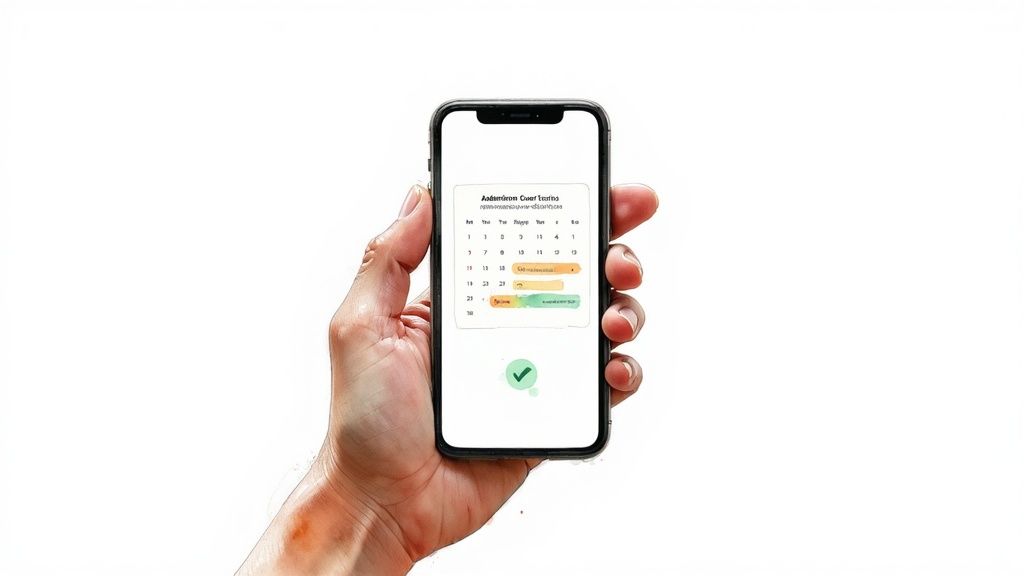
01 / An open slot at 19:00. Players see it live in your club’s app.
Crafting a Frictionless Mobile Booking Experience
Let's be honest. In the time it takes for a player to tie their shoelaces, they want to have a court booked and confirmed. Everything happens on a smartphone these days, and a clunky, slow, or confusing booking app is the fastest way I've seen clubs lose players to the competition down the street. The whole experience has to feel instant.
Your players aren’t just comparing your booking system to other badminton clubs. They’re comparing it to every great app they use daily—from ordering dinner on Deliveroo to hailing an Uber. They expect a clean look, one-tap selections, and a checkout that’s over in seconds, not minutes. Any little bit of friction, like a hard-to-read calendar or forcing them to fill out ten fields, is a reason for them to just give up.
Just look at the screenshot from GoPlay above. That's what you're aiming for: a crystal-clear calendar and simple time slots. It’s all about speed and clarity, letting a player see what’s free and lock it in with just a few taps. That’s the gold standard.
Why You Need Your Own Branded App
A mobile-friendly website is a decent start, but a dedicated, club-branded app is what truly builds loyalty. It puts your club right there on your members' home screens—a constant, subtle invitation to come play. This isn't just about making booking easier; it's about creating a digital home for your community.
With your own app, you control the entire experience from start to finish. You can weave in your club's logo, colors, and unique voice, making it feel like an extension of your physical facility. Every time a member opens it to check court times, you're reinforcing your brand and building that connection.
A great booking app does more than just take reservations. It becomes the digital heartbeat of your club, keeping people engaged and making it effortless for players to be a part of what's happening, anytime and anywhere.
From Search to Confirmation in Seconds
Let’s map out the perfect player journey. A member opens your app and immediately sees a clean, visual calendar. They tap their desired day. All the available time slots pop up, maybe even color-coded to show peak and off-peak pricing. They pick a slot, confirm it, and pay with a saved card in two taps. A confirmation instantly appears on their screen, and an email receipt is already in their inbox.
That whole process should take less than 30 seconds. From my experience, getting it that fast comes down to a few key things:
- A Visual Calendar: Players need to see a week or a month at a glance, with open slots clearly marked. No one wants to hunt and peck.
- One-Tap Time Selection: Ditch the dropdown menus. Let people tap directly on the time they want. It feels much faster.
- Saved Payment Info: This is non-negotiable. Asking members to type in their credit card details every single time is a massive turn-off.
- Instant Confirmations: That immediate feedback gives players peace of mind that their court is locked in and ready for them.
Once you have this down, the app becomes so much more than a booking tool. You can now send out targeted push notifications about last-minute court openings, promote an upcoming tournament, or announce a special members-only clinic. It’s a direct line to your players, helping you keep your club top-of-mind and your courts buzzing with activity.
Automating Payments and Cancellation Policies
Let's be honest, chasing down payments and dealing with last-minute cancellations is a nightmare. It's more than just an administrative headache; it’s a constant drain on your staff’s time and a real threat to your club’s revenue. Automating this entire process is one of the biggest operational wins you can get. It turns a source of friction into a smooth, hands-off system that actually protects your bottom line.
The first move is integrating a secure payment gateway directly into your booking software. There's a reason platforms like Stripe or PayPal are the industry standard—they're incredibly reliable, secure, and your members already know and trust them. This single step immediately makes your booking process feel more professional and trustworthy.
Once that's in place, you can offer different ways for people to pay, which is a huge convenience for your players. It's not about forcing everyone down one path; it's about making it dead simple for them to pay you however they're most comfortable.
Designing Your Payment and Credit System
Think about offering a mix of payment styles to cover all your bases. I've seen a lot of clubs have great success with a tiered approach like this:
- Upfront Payments for Non-Members: This is the easiest way to kill no-shows from casual players. They book, they pay, the court is theirs. Simple.
- Pay-at-the-Venue for Members: For your regulars, this offers a bit more flexibility and shows you trust them. They can just settle up when they arrive for their game.
- Member Credit System: This one is a game-changer. Allow members to pre-load their accounts with credits. It’s a fantastic way to encourage repeat business—players who see a balance in their account are far more likely to book another session.
A credit system also makes handling refunds a breeze. Instead of processing a financial transaction back to a credit card, a cancellation can just pop the credits right back into their account, ready for their next booking.
Implementing a Fair and Firm Cancellation Policy
A crystal-clear, automated cancellation policy is your best defense against the revenue loss that comes from empty courts. Your booking system should be the "bad guy" here, enforcing the rules automatically so your staff doesn't have to have awkward conversations.
Your cancellation policy isn't about punishing players; it's about respecting the value of your court time. A good automated system communicates this policy clearly, fairly, and consistently, which builds trust and minimizes disputes.
Consider a tiered policy that gives players a fair shake while protecting your club's income. Here’s a sample structure that many facilities use as a starting point.
Sample Cancellation Policy Tiers
This table shows a common tiered approach. The key is that the system handles it all automatically based on when the cancellation is made.
| Cancellation Window | Refund Amount | Automatic Action |
|---|---|---|
| More than 24 hours | 100% Refund | Full payment or credits are returned to the user's account automatically. |
| 4 to 24 hours | 50% Refund | A partial refund is processed, retaining a fee to cover the likely loss of booking. |
| Less than 4 hours | No Refund | The full payment is retained to compensate for the last-minute opening. |
An automated structure like this removes all the guesswork. When a player books, the policy is spelled out right there. When they cancel, the system executes the rule without anyone lifting a finger. This frees up your team to focus on what they do best: creating a fantastic experience for the players who are actually at the club.
Think of your booking software as more than just a calendar for your courts. When you treat it as the central nervous system of your entire club, you start to see all sorts of new ways to bring in revenue and create a stickier, more engaged community. It’s a shift from a simple scheduling tool to a true operational command center.
This really starts to click when you integrate services like private coaching and special events right into the booking flow. Suddenly, they aren't separate, disconnected offerings anymore. They become a natural, seamless part of what your club offers. This not only adds a ton of value for your members but helps solidify your club as the go-to spot for everything badminton in your area.

Integrating Coaching and Private Lessons
One of the quickest wins is bringing your coaching staff online. A good booking system lets you build out detailed profiles for each coach, showing off their specialities, certifications, and a quick bio. This is huge—it gives your players a chance to get to know your pros and find the perfect match for their skill level and goals.
From there, you link each coach’s profile to their live availability. Just imagine a player scrolling through your app. They see their favorite coach, Sarah, has an open slot at 4 PM on Wednesday. A few taps later, they’ve booked a private lesson. The system should be smart enough to reserve both Sarah’s time and a court, eliminating any chance of a double-booking headache.
Setting up the money side of things is just as straightforward. For instance, a high-end resort like La Quinta prices its private tennis lessons at $140/hour, semi-privates at $160, and clinics at $45. You can easily model a similar structure for badminton:
- Private Lessons: Set a premium hourly rate for that focused, one-on-one training.
- Group Clinics: Offer a lower price per person for small groups, making coaching more accessible and social.
- Junior Programs: Sell multi-week packages for kids' programs, getting that revenue locked in upfront through the app.
This whole approach turns your coaches' time and expertise into a profitable service that members can book with zero friction.
By making coaches and their schedules visible and bookable online, you remove all the friction. Players no longer have to coordinate between the front desk and the coach; they can see everything they need and book a session instantly.
Managing Tournaments and Events
Your booking platform is also your secret weapon for organizing bigger events—think tournaments, holiday camps, or even just social member mixers. The magic lies in having a system that can handle block bookings and group registrations without breaking a sweat.
Instead of your staff manually blocking out eight courts for a Saturday tournament, you can do it in a single action within the system. This instantly walls them off from regular member bookings and dedicates them to the event. The next step is to create a custom online registration page. This page can handle everything from collecting entry fees and asking for player skill levels to automatically managing the participant list.
This is a massive time-saver. All your event communications, from the initial announcement to last-minute schedule changes, can be blasted out to all registered players through the platform. It keeps everyone in the loop and dramatically cuts down the administrative load on your team, letting them focus on what really matters: running a fantastic event.
Using Data to Optimize Court Usage and Revenue
Your booking software is more than just a digital calendar—it's a goldmine of data working for you 24/7. Every single reservation, cancellation, and check-in tells a story. Learning to read that story is the key to making smarter, more profitable decisions for your club.
Instead of guessing what your members want, you can see their actual behavior laid out in black and white. This shifts you from a reactive management style to a proactive, data-driven strategy, making sure your facility is always running at its peak. It all starts with tracking a few crucial numbers.
Key Metrics to Start Tracking Today
Don't get buried in spreadsheets. The trick is to focus on the numbers that have a direct impact on your operations and your bottom line. Any good booking system will serve this information up in a clean, easy-to-read dashboard.
Think of these as the vital signs for your club’s health:
- Court Utilization Rate: This is your north star metric. It’s simply the percentage of your available court time that actually gets booked. A solid goal to aim for is 70-80% during your peak hours.
- Peak vs. Off-Peak Bookings: Pinpoint your busiest and quietest times with absolute certainty. You might just find out that Thursday evenings are a hidden primetime slot, or that Wednesday mornings are a ghost town.
- Player Booking Frequency: Who are your regulars? Identifying members who book multiple times a week helps you spot your most loyal, high-value customers.
- Lead Time for Bookings: How far ahead are people planning? If you notice most bookings happen within 24 hours of court time, you can launch promotions aimed squarely at those last-minute players.
Turning Insights into Actionable Strategies
Once this data starts rolling in, you can make targeted improvements that really move the needle. For instance, if your analytics reveal that your courts are only at 20% capacity on weekday mornings, that's not a failure—it's a massive opportunity.
You could launch a "Morning Shuttle" special, offering a discounted rate for any bookings between 9 AM and 12 PM. A simple, data-backed move like this can turn your quietest hours into a brand-new revenue stream. In the same way, knowing who your most frequent players are lets you reward them with a small loyalty perk, which goes a long way in strengthening their connection to your club.
Your booking data tells a story about your club. Analyzing court utilization and player habits allows you to find the plot holes—like empty time slots—and write a more profitable ending.
This kind of informed decision-making is becoming non-negotiable. The global badminton equipment and facilities market is expected to reach about USD 3.2 billion by 2025, fueled by a huge surge in players worldwide. You can dig into more details on this growth trend over at Archive Market Research.
This data-first approach lets you fine-tune everything, from your pricing strategy to your marketing campaigns. If you want to get a clearer picture of your own club's potential, try plugging some numbers into our simple badminton court revenue calculator to see how different utilization rates could impact your income.
Ready to unlock the data hiding in your schedule? Book & Go provides the powerful analytics and management tools you need to optimize court usage, increase bookings, and grow your revenue. Explore our features and get a personalized demo today.