So, what exactly is booking software? Think of it as the digital command center for your club or studio. It's the system that works 24/7 behind the scenes—handling everything from court reservations and class sign-ups to payments and member communications—so you don't have to.
Beyond the Calendar: Why Your Club Needs Booking Software
Picture your club’s front desk. Is it a calm, organized hub, or more like a chaotic air traffic control tower? When you're juggling phone calls, scribbling in paper calendars, and manually chasing payments, you're practically inviting chaos, double bookings, and frustrated members.
Booking software is your advanced radar and scheduling system. It’s what prevents those collisions, manages the flow of people, and makes sure everything runs smoothly, on time, every time. For any modern padel club, tennis academy, or wellness studio, this isn't just a fancy digital calendar; it's the central nervous system of your entire operation. It's built to solve the critical, everyday problems that drain your team's time and energy.
Solving Critical Operational Challenges
A good booking system doesn't just help you react to problems—it proactively stops them from ever happening. If you've ever looked into top business process automation software, you'll have a sense of how powerful this can be. By automating all the tedious, repetitive tasks, you free up your staff to focus on what they do best: creating an incredible experience for your members.
Here are the key problems a booking system just makes disappear:
- Eliminating Double Bookings: The system is built to know that a court, a spot in a yoga class, or a private lesson slot can only be booked once. No more awkward apologies or frustrated members.
- Reducing Administrative Overload: Forget endless phone calls and manual follow-ups. The software handles confirmations, sends out reminders, and manages waitlists automatically, saving your team countless hours.
- Capturing Missed Revenue: By taking payments online at the time of booking and automatically enforcing your cancellation policy, you secure revenue that would otherwise vanish with no-shows or last-minute cancellations.
This isn't just about making life easier; it's a major strategic shift happening worldwide. The global booking software market is expected to balloon from USD 299.1 billion in 2025 to USD 473 billion by 2033. Why? Because businesses everywhere are realizing the massive efficiency gains that come from smart digital tools. Discover more insights about these market trends.
By taking over the repetitive, time-consuming tasks, booking software empowers your team to shift from administrative roles to experience-focused hosts, directly boosting member loyalty and engagement.
At the end of the day, this software provides the crystal-clear data you need to make smarter business decisions. You'll know exactly how to optimize court schedules, which classes are most popular, and where your growth opportunities lie. It's the foundation for building a club that's scalable, efficient, and completely centered around your members.
The Core Features Every Modern Booking System Needs
It's easy to get lost in a sea of shiny features when you're looking at booking software. But before you start comparing all the bells and whistles, you have to get the fundamentals right. A handful of non-negotiable tools form the bedrock of any system that's actually going to work for your club. These are the workhorses—the core features that automate the daily grind and have a direct line to your club's efficiency and your members' happiness.
Think of it like building a house. You wouldn't dream of picking out paint colors before you have a solid foundation, sturdy walls, and a reliable roof. These core features are your club's digital foundation. They ensure your operations are stable, secure, and ready to grow. Without them, even the most advanced add-ons are just window dressing.
This focus on core functionality isn't just a trend; it's the standard. The global market for online booking systems was valued at a massive USD 3.5 billion in 2023 and is on track to more than double, hitting USD 7.1 billion by 2032. This explosion is fueled by one simple thing: your members now expect easy, digital-first experiences.
The infographic below really brings this to life, showing how these core features prop up the three pillars of a successful club.
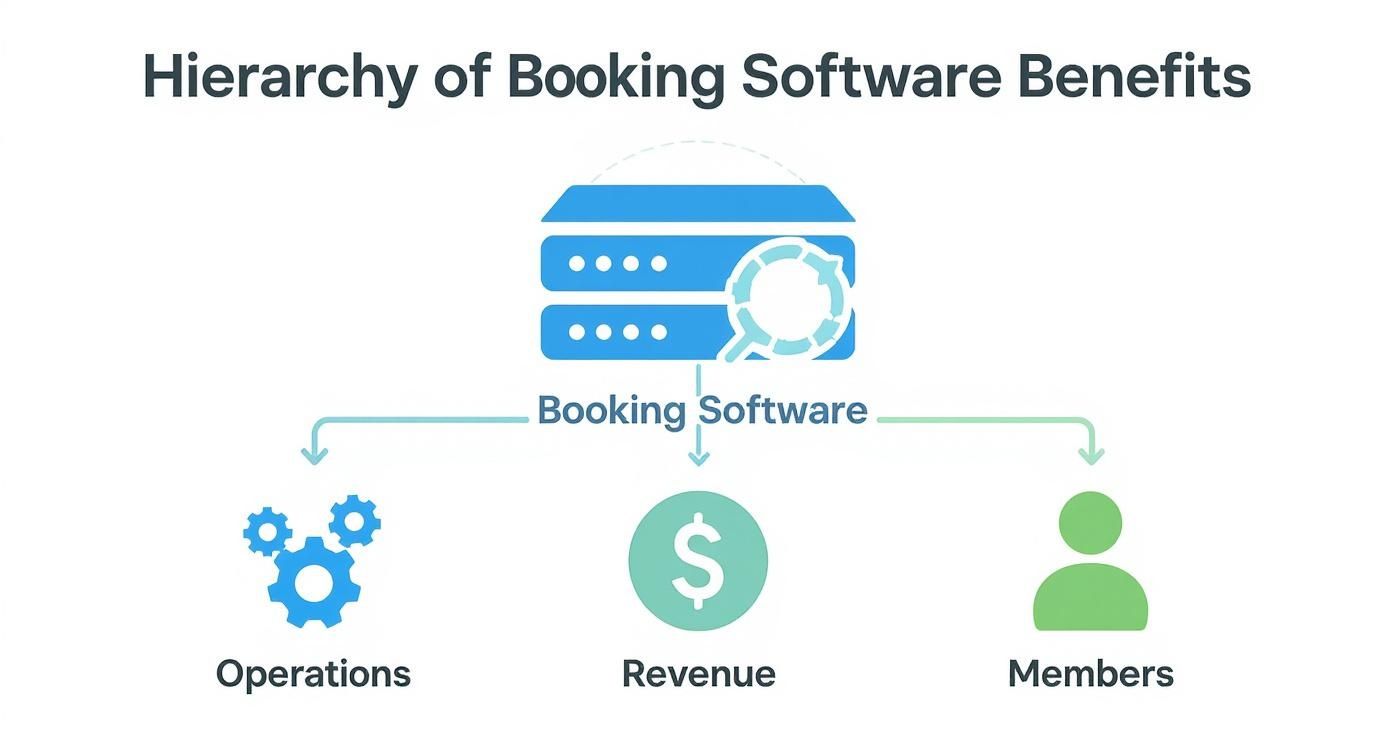
As you can see, the right software isn't just a tool; it's a strategy that simultaneously smooths out your day-to-day operations, drives revenue, and keeps your members coming back.
Online Booking Calendar and Scheduling
At the very heart of it all is the online calendar. This is your club’s digital front door, and it needs to be open 24/7. It’s what lets members book a court, grab a spot in that popular yoga class, or schedule a lesson with a pro whenever inspiration strikes—not just when your front desk is staffed. No more phone tag, no more missed revenue.
A truly great scheduling tool gives everyone a real-time view of what's available, killing the dreaded double-booking that frustrates members and creates a mess for your staff. It becomes the single source of truth for your entire operation.
The primary goal of a core scheduling feature is to make booking effortless for members and foolproof for staff. It should be intuitive enough for a new member to use on their phone in seconds.
Here’s what a robust calendar absolutely must deliver:
- Real-Time Availability: The schedule has to update instantly the moment a booking is made—whether online or by your staff—so everyone is looking at the same, accurate information.
- Resource Management: It needs to be smart enough to manage all your different resources, from individual tennis and pickleball courts to specific rooms in your wellness studio.
- Intuitive Interface: The calendar has to be clean, simple to navigate, and work flawlessly on a phone. Let's be real, that's where most of your members are booking from.
Integrated Payments and Invoicing
Let's talk about the time drains. Manually chasing payments, sending invoices, and handling cash are huge productivity killers that also throw your cash flow into question. Modern booking software completely solves this by weaving payment processing right into the booking itself.
This changes everything. You can require payment upfront to lock in a booking, which automatically enforces your cancellation policies and pretty much eliminates no-shows. When a member books, their payment is handled securely, right then and there.
Key payment features include:
- Secure Payment Gateway Integration: It has to connect with trusted processors like Stripe to handle credit card transactions safely and professionally.
- Automated Invoicing: The system should generate and email professional invoices on its own for memberships, court packs, or one-off bookings.
- Stored Payment Methods: Giving members the option to save their card details for quick, one-click future bookings is a game-changer for their experience and keeps them coming back.
Member Management and Communication
Your members are the lifeblood of your club, and your booking software should treat them that way. A core feature is a centralized, secure database to manage all your member information. This is so much more than a simple contact list.
It’s your command center for tracking member activity, managing different membership tiers, and—critically—communicating effectively. You can see how this foundation supports more advanced tools by exploring a detailed overview of modern club management features.
A good system gives you the power to automate the kind of communication that keeps your club running smoothly:
- Automated Reminders: Sending booking confirmations, reminders, and follow-ups through email or push notifications is the single best way to slash your no-show rate.
- Waitlist Management: When a spot opens up in a sold-out class or on a prime-time court, the system should automatically notify the next person on the waitlist. You fill empty slots without lifting a finger.
- Targeted Announcements: Imagine sending a message about a new clinic only to your intermediate-level tennis players. This kind of targeted communication is incredibly powerful.
01 / An open slot at 19:00. Players see it live in your club’s app.
Advanced Tools That Fuel Growth and Member Loyalty
Mastering the core features of your booking software is like learning the basic strokes in tennis—absolutely essential to play the game. But to really compete and win in today's market, you need advanced strategies. This is where your booking software transforms from a simple operational tool into a powerful engine for growth, member loyalty, and smarter business decisions.
These are the features that ambitious, multi-location clubs and studios lean on to build a serious competitive edge. It’s about moving beyond just managing the day-to-day and starting to actively build your brand, deepen member relationships, and uncover hidden revenue streams. It’s the difference between just running a club and strategically growing an enterprise.
Branded Mobile Apps and White-Label Solutions
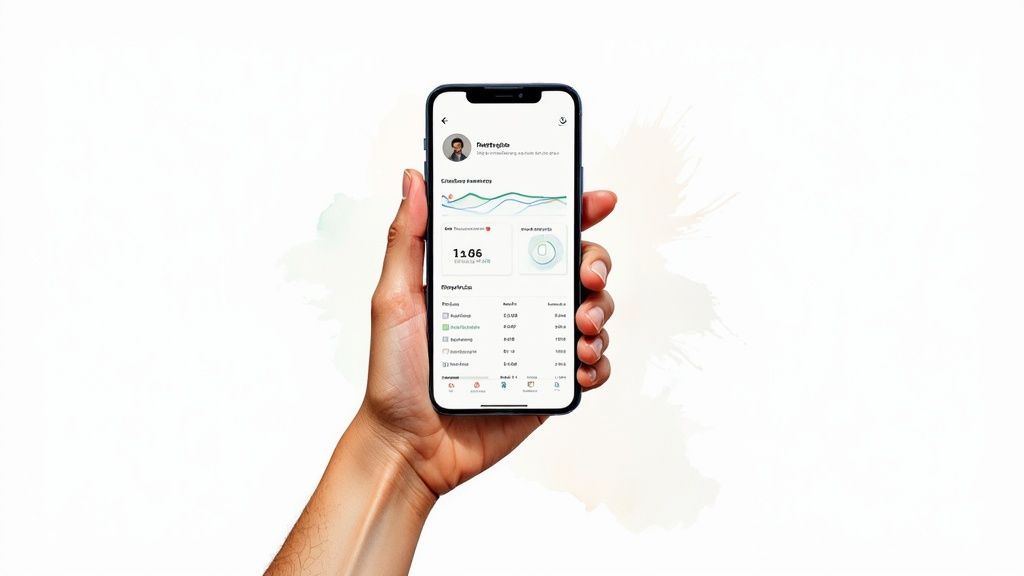
Let's be honest, your brand's presence on a member's phone is prime real estate. A generic, third-party booking portal just doesn't cut it anymore. A white-label mobile app puts your club’s logo, colors, and unique identity directly into every member's pocket, creating a seamless and immersive brand experience.
This is much more than a cosmetic upgrade. When members open an app that looks and feels like your club, it reinforces brand loyalty and trust. Every push notification, every booking confirmation, and every interaction strengthens their connection to your community, not to some software company they've never heard of.
Sophisticated Analytics and Reporting
Gut feelings can only get you so far. Real, sustainable growth is driven by data. Advanced booking software provides the kind of business intelligence you need to make informed decisions that directly impact your bottom line. It turns a mountain of raw booking data into genuinely actionable insights.
Think of it as having a consultant on your team who can finally answer your most critical questions:
- Court and Class Utilization: Which courts are most popular and at what times? Are your morning yoga classes always full while the afternoon sessions are struggling to get traction?
- Revenue Analysis: Which membership tiers are actually the most profitable? How much are you making from drop-in players versus your loyal regulars?
- Member Behavior: Who are your power users? What’s the average booking frequency, and how does it change with the seasons?
With powerful analytics, you stop guessing and start knowing. You can optimize schedules for maximum occupancy, adjust pricing based on real-time demand, and identify your most valuable members so you can reward their loyalty.
For a pickleball franchise, this could mean using centralized reporting to see which class formats are crushing it before rolling them out to a new location. For a wellness studio, it might mean analyzing instructor popularity to tweak the weekly schedule and fill more spots.
Marketing Automation and Loyalty Programs
Getting a new member through the door is one thing; keeping them engaged and coming back for the long haul is a whole different ball game. Advanced booking software often comes with marketing automation tools designed to build and nurture your community, turning casual visitors into dedicated advocates.
This means you can set up automated email and push notification campaigns that are triggered by specific member actions. For example, you can automatically send a "we miss you" offer to members who haven't booked in 60 days or a celebratory message on their membership anniversary. These personalized touchpoints make members feel seen and valued.
On top of that, integrated loyalty programs are a game-changer for retention. You can create systems where members earn points for every booking, referral, or pro shop purchase, which they can redeem for discounts, free classes, or merch. It gamifies engagement and gives members a real, tangible reason to choose your club over a competitor. The next wave of this is already here, and you can learn more about how artificial intelligence is changing court booking systems in our latest article. This is how you build a thriving, loyal community that becomes your single most effective marketing channel.
How to Choose the Right Booking Software
Picking the perfect booking software for your club or studio can feel like you're staring at a wall of options, each one shouting about its features. It’s easy to get lost. The secret is to step back and create a simple framework that puts your club's actual needs—both for today and down the road—at the center of the decision.
Think of this less as buying a tool and more as investing in the very backbone of your operations. The right choice will free up your time, open up new revenue streams, and give your members an experience they’ll love. But the wrong one? That path leads to frustrated staff, members walking away, and a never-ending cycle of clunky workarounds. Let’s make sure you make a confident decision that truly serves your business.
Define Your Core Needs and Priorities
Before you even think about watching a single product demo, you need to get crystal clear on what problem you're actually trying to solve. Start by sketching out your current day-to-day processes and pinpointing the biggest headaches. Is your front desk constantly tied up on the phone? Are no-shows eating into your profits? Does your current system just fall apart when you try to manage multiple courts or a complex class schedule?
Make a simple checklist: what are your absolute non-negotiables, and what would be "nice to have"? This list will become your North Star, helping you cut through all the marketing fluff and focus on what really matters.
- Must-Have Features: These are your deal-breakers. Things like real-time online booking, secure payment processing, and automated reminders fall squarely in this camp.
- Important Features: These are the game-changers that would make a serious difference, like a branded mobile app for your members or smart waitlist management.
- Future-Proof Features: Think about where you're headed. Do you see yourself needing multi-location support or deep-dive analytics in a year or two?
Don’t get distracted by a single, flashy feature. A solid foundation that solves your biggest daily problems is infinitely more valuable than a shiny tool that does one niche thing well but can't handle the basics.
Evaluate Scalability and Customization
Your club is growing and changing, and your software needs to keep up. A platform that’s fine for a single-court operation today might completely buckle under the pressure of a multi-location franchise. Scalability is all about the software’s ability to grow with you—handling more members, more locations, and more complex schedules without skipping a beat.
Just as important is the power of customization. Your brand is everything. Can the software be white-labeled to look and feel like your club, with your colors and logo? This is absolutely critical for creating a professional, seamless experience for your members. A big part of your decision will be weighing the pros and cons of custom software versus off-the-shelf solutions, as this choice directly impacts how well you can integrate your brand.
Assess User Experience and Support
The most powerful booking software in the world is useless if your staff and members can't figure it out. The user experience (UX) has to be dead simple for everyone. When you get a demo or a free trial, put it to the test from two different angles:
- The Member View: Pretend you're a member. Try to find and book a court or a class on your phone. Is it easy? Is the payment process smooth and quick?
- The Admin View: Get your staff to play around on the back-end. Can they manage schedules, look up member info, and pull key reports without needing a user manual? A good system should lighten their load, not add to it.
And don't forget what happens after you sign up. When something goes wrong on a busy Saturday morning, you need fast, competent help. Look into their customer support options—do they offer phone, email, and live chat? Is there a good online help center? The market for this tech is exploding; appointment scheduling software was valued at USD 470.7 million in 2024 and is expected to hit USD 1.52 billion by 2032, driven by features that make clubs run better. Learn more about these market dynamics and the tech behind this growth. A vendor’s commitment to great service is a pretty clear signal of their commitment to your success.
Executing a Smooth Software Implementation Plan
Rolling out new booking software should feel like a game-winning point for your club, not a source of headaches and confusion. A successful launch all comes down to a clear, well-thought-out plan that breaks the whole process down into simple, manageable steps. This is your game plan for a seamless switch that gets everyone—from your front-desk staff to your most dedicated members—genuinely excited for the upgrade.
The whole point is to keep disruptions to a minimum and get everyone using the new system from day one. Think of it like resurfacing a court: you have to prep the surface, apply the new layer with care, and give it time to cure before anyone steps on it. Rush any of those steps, and you’ll end up with a mess.

Stage 1: The Pre-Launch Foundation
This first phase is all about getting your ducks in a row, and honestly, it’s the most important part of the entire project. Before you even dream of flipping the switch, you need to get your data and your team ready. This is where you lay the groundwork that prevents problems down the road.
Your first big task is data migration. This means carefully pulling all your member information, existing bookings, and payment histories out of your old system (or those spreadsheets!) and getting it into the new software. A quality provider will have your back here, offering support to make sure no member’s data gets lost in the shuffle.
Next up, you’ll focus on system configuration. This isn't just a technical to-do list; it’s about teaching the software how your club actually runs.
- Set Up Your Resources: Define every court, room, and instructor in the system.
- Establish Booking Rules: This is where you program your policies for booking windows, cancellation fees, and prime-time pricing.
- Configure Membership Tiers: Build out your different membership levels with their specific booking rights and pricing.
Stage 2: Staff Training and Internal Buy-In
Let's be real: your new software is only as good as the people who use it every day. Your staff are your champions for this change. If they feel confident and positive about it, that energy will spill over to your members. One of the biggest mistakes clubs make is rushing the training.
Schedule dedicated training sessions that are more than just a quick demo. Give your team a "sandbox" or test environment where they can click around and even make mistakes without any real consequences. Focus on the things they’ll do a dozen times a day: making a booking, taking a payment, and looking up a member's account.
"The number one reason we switched... was because the online booking is so easy for the guest compared to other systems... Similarly, your reservationists deserve to experience the same ease of software use." - Courtney Belmont, General Manager of Greenbrier Campground
Courtney’s point is spot on. The system has to work brilliantly for your team just as much as it does for your members. When the software makes their jobs easier, they'll become its biggest fans.
Stage 3: The Member Onboarding and Go-Live
With your data in place and your team prepped, it's time to bring your members into the loop. Communication is everything here. Don't just announce the switch; sell them on the benefits. You want to frame this new system as a massive upgrade to their club experience.
Here’s a simple communication timeline:
- Teaser Announcement (2 Weeks Out): Send an email to get them excited. Highlight killer benefits like 24/7 booking from their phone or one-click class sign-ups.
- Detailed Instructions (1 Week Out): Follow up with clear, step-by-step instructions for downloading the new app or logging into the web portal.
- Launch Day Blast: On the big day, send one more announcement with direct links and a quick reminder of who to contact if they need a hand.
On go-live day, make sure you have some extra hands on deck to help members who might have questions. A smooth, well-supported launch proves you invested in this new booking software to make their lives better, which goes a long way in building loyalty.
7. Measuring Success and Proving Your ROI
https://www.youtube.com/embed/O-wq-C-52NY
So, you’ve put the time and money into a new booking system. How do you actually prove it was worth it? The answer isn't about gut feelings or just feeling like things are running smoother. It’s about hard data. By tracking the right numbers—what we call Key Performance Indicators (KPIs)—you can turn those abstract benefits into concrete proof that shows the software's true value.
This isn’t about building some complex financial model. It’s about measuring the things that really matter to your club’s health: how efficiently you're running, how happy your members are, and whether you're bringing in more money. The beauty is, your new software is a goldmine of this exact data, making it easier than ever to calculate your Return on Investment (ROI) and show everyone the move paid off.
Key Performance Indicators to Track
Before you can measure success, you have to define what it looks like. For a club or studio, that’s usually a combination of a fuller schedule, a less-stressed team, and a healthier bottom line. Your booking software gives you a direct window into all of these areas.
Start by keeping an eye on these essential KPIs:
- Increased Utilization Rate: This is the percentage of your courts or class spots that are actually booked. A higher number here means you’re squeezing every last drop of value from your most important assets.
- Reduction in Administrative Hours: How much time is your team no longer spending on the phone, manually shuffling schedules, or chasing down payments? That time saved is money saved, or better yet, time reinvested into member engagement.
- Growth in Membership Renewals: A slick, easy booking experience is a huge part of what keeps members happy. Tracking renewal rates before and after you switched systems will tell you a lot about loyalty.
- Reduced No-Show Rate: Never underestimate the power of automated reminders. A drop in no-shows means more guaranteed revenue from appointments that people actually attend.
The real goal here is to shift your booking software from being just another expense to being a powerful engine for revenue. The data it gives you is the roadmap for growing your business.
Calculating Your Return on Investment
Once you’re tracking these KPIs, calculating your ROI is pretty straightforward. The basic formula is simple: (Financial Gain - Cost of Software) / Cost of Software. Your "Financial Gain" is just the sum of all the improvements you’ve measured with your KPIs.
Let's run a quick example. Imagine your new software cuts down your admin work by 20 hours a month, and your staff is paid $20/hour. Right there, that’s a $400 monthly saving. On top of that, let's say it helps you fill five extra class spots every week at $25 a pop. That's another $500 in new revenue each month.
With a combined gain of $900 a month, proving the software's ROI becomes a no-brainer. You can even start projecting future earnings. To get a feel for how these numbers might look for your specific club, check out this handy revenue calculator for sports facilities. This kind of data-driven thinking not only confirms you made the right call but also shines a light on new ways to grow.
Frequently Asked Questions About Booking Software
You're not alone. When you get serious about choosing booking software, the same questions tend to pop up for every club and studio owner. Getting straight answers is the only way to feel confident you're making the right call.
We'll cut through the noise and tackle the most common queries we hear every day. Think of this as your final checklist before you commit.
Is My Member Data Secure with Cloud-Based Software?
It’s a great question, and the short answer is: absolutely. Any reputable cloud-based provider takes your data security far more seriously than most individual businesses ever could. They rely on heavy-duty tools like data encryption and secure servers, often built on powerhouse infrastructure from companies like Amazon Web Services (AWS).
The bottom line is their entire business model rests on keeping your data safe. When you're comparing options, look for their security protocols, how they handle data backups, and if they comply with privacy laws like GDPR. This isn't just a feature; it's a fundamental requirement.
Can Booking Software Integrate with My Website?
Yes, and it should be completely seamless. A modern booking platform is designed to plug right into your existing website, whether you’ve built it on WordPress, Squarespace, or Wix.
Most give you a simple widget or a link to embed on your site. For your members, this means they can book a court or class without ever feeling like they've left your digital home. The same goes for payment gateways like Stripe or PayPal—the whole process should feel like a natural part of your brand experience.
The best software becomes an invisible extension of your brand. Your members shouldn't even notice it's there; they should just feel how easy it is to book with you.
How Much Does Booking Software Typically Cost?
This is the classic "it depends" question, but we can break it down. Pricing really hinges on what you need—the number of features, how many members you have, or how many locations you're running.
You’ll typically see a monthly subscription model. For a small, single studio, you might find a basic plan for under $50 a month. For a large club or a growing franchise with complex needs, that could scale up to several hundred dollars. Always hunt for a transparent pricing page and don't be shy about asking about hidden costs. Things like setup fees, payment processing percentages, or charges for "premium" features can sometimes be tucked away in the fine print.
Ready to see how a booking platform built around your brand can change the game? Book & Go gives you a white-label mobile app and all the management tools you need to create an incredible member experience and make running your club easier. Discover the Book & Go difference today.