So, you're thinking about starting a pickleball ladder league? Smart move. It’s one of the most dynamic and engaging ways to get people playing regularly. In a nutshell, a ladder league ranks players, and they challenge each other to climb their way to the top. The beauty of it is that matches are usually set up weekly based on those rankings, so everyone consistently plays against others at a similar skill level.
The Ultimate Playbook for Your Pickleball Ladder League
Welcome to the definitive playbook for launching and running a pickleball ladder league that people can't stop talking about. This guide is built for the club managers, community organizers, and die-hard players who want to go beyond just scheduling matches and create a truly awesome, competitive scene.
We’re going to skip the fluff and dive straight into actionable strategies. You'll get the inside scoop on designing formats that keep everyone hooked, setting up crystal-clear rules to avoid drama, and even using tech to handle the tedious admin work. This whole playbook is built on three pillars: giving players an amazing experience, guaranteeing fair competition, and creating a league that’s built to last. A great league doesn't just happen by accident; it's planned with care.

Core Components of a Successful League
Before we get into the nitty-gritty, let's zoom out and look at the handful of things that absolutely have to be in place. Get these right, and you've built the foundation for a league that practically runs itself.
- Thoughtful Format Design: This is more than just saying "it's a ladder." You need to decide on match length, scheduling windows, and how you’ll group players each week to keep things fresh.
- Clear and Concise Rules: A solid, easy-to-understand rulebook is your best friend. It needs to cover everything from scoring and finding subs to what happens when someone doesn't show up.
- Efficient Player Management: This is all about making life easy for your players (and you!). Think simple sign-ups, clear communication, and a foolproof way to track who’s playing each week.
- Fair Ranking System: The heart of your ladder is its ranking system. It has to be a system that players trust and that accurately reflects how they're performing over time.
A well-run pickleball ladder league does more than just schedule games; it builds a community. The goal is to create a system where players feel challenged, see progress, and connect with others who share their passion for the sport.
To give you a quick cheat sheet, the table below breaks down these core components. Think of it as your high-level checklist for everything we're about to cover in detail.
Core Components of a Successful Ladder League
Here's a snapshot of the essential elements needed to plan and launch a thriving pickleball ladder league.
| Component | Key Objective | Best Practice Example |
|---|---|---|
| Format & Rules | Promote fair and consistent competition. | A challenge-based ladder where players can challenge up to 3 spots above them within a 7-day window. |
| Scheduling | Maximize court time and player convenience. | Fixed weekly time slots (e.g., Tuesdays at 6 PM) to create a consistent, social atmosphere. |
| Player Management | Simplify administration and communication. | Using a club management app like CourtReserve for signups, fee collection, and automated weekly matchup notifications. |
| Ranking System | Ensure rankings accurately reflect skill. | An Elo-based rating system that adjusts scores based on the outcome and the relative skill of the opponent. |
| Community Building | Foster engagement and player retention. | Hosting a season-end social event to celebrate top performers and gather feedback for the next league. |
Getting these pieces right from the start is the key to building momentum and creating a league that players are excited to join season after season.
Designing Your League Format and Rules
The foundation of any great pickleball league isn't just a list of players—it's the structure. The format and rules are the blueprint for the entire player experience, ensuring things run fairly and keeping everyone excited to show up each week.
Nailing this down from the start saves you a world of headaches later on. It keeps the focus where it should be: on fun, competitive pickleball. Your first big decision is choosing the right ladder model for your group.
Choosing Your Ladder Model
The model you pick really sets the tone for the league. Think about your players' competitive level and what kind of vibe you're going for.
A challenge-based ladder is a classic. Players can directly challenge others ranked a certain number of spots above them—for example, anyone up to three spots higher. This format is fantastic for sparking direct rivalries. The only potential downside is that top players can sometimes get challenged less often once the rankings settle in.
Another popular choice, and one of my favorites for ensuring consistent play, is a box league. You group players into "boxes" of four or five based on skill. For a set period, like a week or two, everyone in a box plays each other. At the end of the round, the top player moves up a box and the bottom player moves down. This guarantees everyone gets a good mix of matches against people at their level.
Then there's the pyramid system. It's super visual and easy to grasp. Players start at the bottom and can only challenge someone in the row directly above them. Win, and you swap places. It's straightforward, but it can create bottlenecks, making it tough for a skilled player at the bottom to climb the ranks quickly.
Establishing Clear Scoring and Match Rules
Once you have a format, you need to define the rules of engagement. Ambiguity is the enemy of a smooth-running league, so get specific.
Start with scoring. The standard is pretty simple: games to 11 points, win by two. Sticking to this format means most players will already know what to do. Then, decide if a match is a single game or a best two-out-of-three series. A single game is quicker and lets you pack more action into one session, but a full series feels more decisive.
Here are a few other critical rules to lock down from day one:
- Match Scheduling Window: Are matches played during a set time each week (like every Wednesday from 6-8 PM), or do players have a full week to schedule on their own? Fixed times are a game-changer for building community.
- Score Reporting: How are scores submitted, and by when? A simple online form or an app is usually your best bet. Make it clear who's responsible—the winner, both players, or a designated court captain.
- Substitutions: What’s the plan when someone can't make it? Have a clear process for finding and approving subs. Does the sub need to be from an approved list or have a similar skill rating?
Pro Tip: When setting up weekly play, try to create groups of five, even if it feels less tidy than four. If someone inevitably cancels at the last minute, the remaining four can still have a great round-robin session without the whole thing falling apart.
Creating a Fair and Transparent Ranking System
Your ranking system is the engine that drives the competition. It has to feel fair, accurate, and be easy for everyone to understand.
A simple win/loss record is a start, but it doesn't tell the whole story because it fails to account for the quality of your opponents.
For a more accurate reflection of skill, consider an Elo-based rating system. These dynamic ranking models, borrowed from the world of chess, are why modern pickleball leagues feel so competitive. Points are awarded based on who you beat; upsetting a higher-ranked player earns you way more points than beating a lower-ranked one.
No matter what you choose, transparency is everything. Players need to see the updated leaderboard and understand why their position changed. If you're running a more complex structure, our guide on how to create a tournament bracket has some great tips that can also apply here.
Finally, have a written plan for disputes, no-shows, and forfeits. A "no-show," for example, might result in a forfeit plus a small point penalty. Putting these rules in writing and sharing them upfront saves you from being the bad guy and ensures everyone plays by the same standards.
01 / An open slot at 19:00. Players see it live in your club’s app.
Mastering Logistics: Player Management and Scheduling
You’ve got a solid format and clear rules. Now comes the real work: the operational heartbeat of your pickleball league. This is all about managing your players and scheduling matches.
A little organization here goes a long way, turning what could be administrative chaos into a smooth, fun experience for everyone. The goal? Make it effortless for players to participate and straightforward for you to manage.
Your first impression is the registration process. It sets the tone for the whole league, so keep it simple, clear, and focused on getting only the essential info. An online form is the standard for a reason—it’s just plain efficient.
Streamlining Player Registration and Communication
Think of your sign-up form as more than just a name collector. It’s your chance to get everything you need upfront and slash the amount of back-and-forth communication you'll have to do later.
Here’s what you absolutely need to ask for:
- Contact Info: Names, emails, and phone numbers are non-negotiable. That phone number is your lifeline for last-minute changes or day-of coordination.
- Skill Level: Ask players for a self-rating, whether it's their DUPR or a simple 2.5-4.0 scale. This is crucial for initial seeding and making sure those first-week matchups are balanced.
- Waivers and Fees: Get this done from the start. Integrate digital waivers and payment directly into your sign-up form. You can pair a Google Form with PayPal, or use dedicated sports software to handle it all. Collecting fees upfront guarantees commitment.
Once players are signed up, communication is everything. The first thing you should do is send out a well-crafted welcome email. Confirm their registration, link to the rulebook, explain how they'll get their weekly matchups, and set expectations for the season. This one email can probably answer 80% of the questions you'd otherwise get hit with one by one.
Managing Player Availability and Crafting Schedules
One of the biggest headaches in any league is dealing with player availability. Life happens. People have vacations, work conflicts, and last-minute emergencies. Your scheduling system needs to be flexible enough to handle this reality without derailing the whole league.
A simple and incredibly effective method is a weekly availability poll. Use a tool like Doodle or a basic Google Form. Send it out on Thursday for the following week's matches and set a hard deadline for Sunday night. This gives you a clear headcount and lets you build the schedule with confidence.
Pro Tip: Build your player pool larger than your weekly court capacity. If you can fit 20 players on the courts each week, aim for a total roster of 30. This creates a natural buffer for absences and ensures you can always fill every spot.
This process, from defining the format to managing the schedule, is a connected flow.
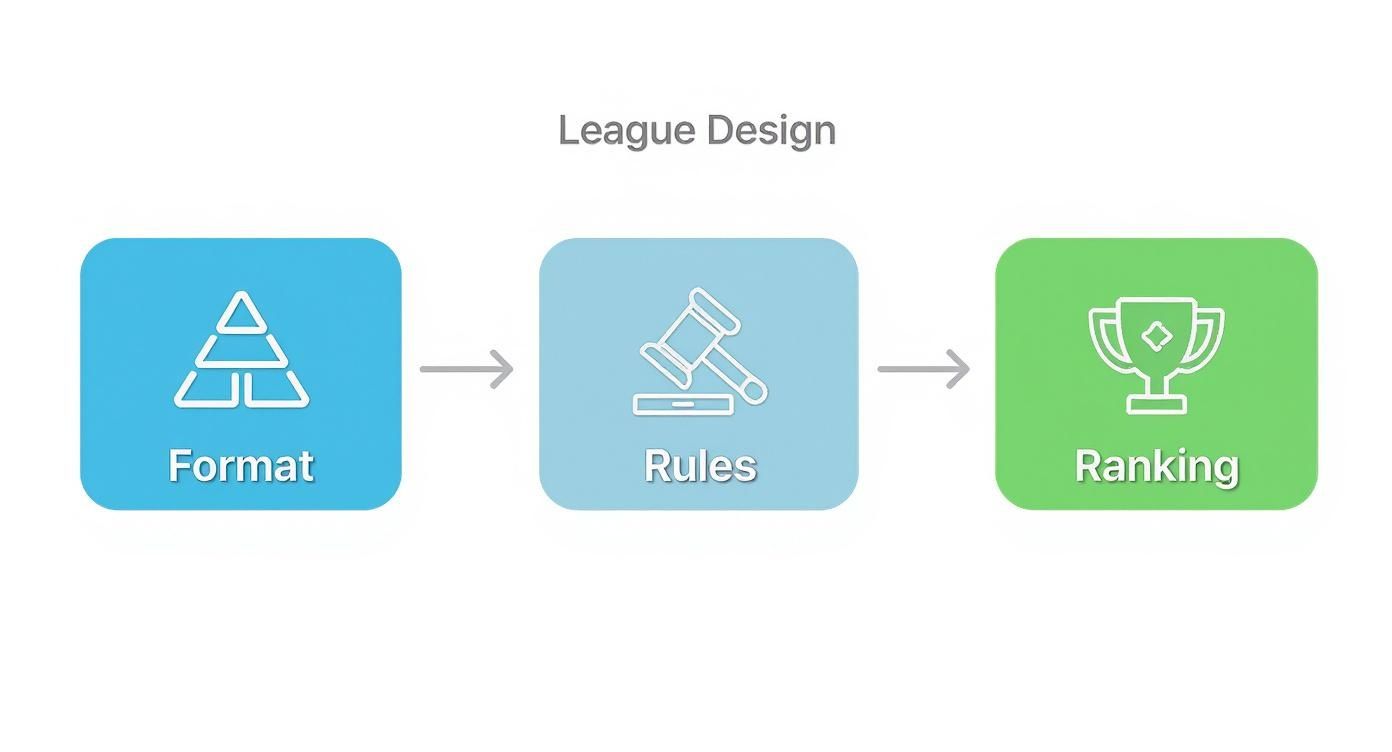
As the graphic shows, a well-defined format and rule set are the foundation for any effective scheduling and ranking system.
Essential Tools for League Management
You don't need a massive tech stack to run a great pickleball league, but the right tools can save you a ton of time. Your choice really comes down to your league's size, your budget, and how comfortable you are with technology.
For smaller, more casual leagues, a combo of free tools can work wonders:
- Google Sheets: This is your command center. Create tabs for player contacts, weekly availability, the master schedule, and your live ladder rankings. It's free, collaborative, and accessible from anywhere.
- Google Forms: The perfect partner for Sheets. Use it for initial sign-ups and weekly availability check-ins. All the responses feed right into a spreadsheet, keeping your data neat and tidy.
- Email or WhatsApp: Set up a league-specific group. It's the best way to send out weekly matchup announcements, reminders, and last-minute updates. Having that direct line of communication is invaluable.
Once your league starts to grow, or if you just want to offer a more polished experience, dedicated league management software is a game-changer. Platforms like Global Pickleball Network or CourtReserve are built for this. They automate pretty much everything—registration, payments, and even creating weekly matchups based on the latest rankings. Often, players can report their own scores, which instantly updates the leaderboard and takes you out of the middle. They do come with a cost, but the time you save and the better player experience are almost always worth it.
Choosing the Right Tech to Run Your League
Technology can be your best friend or your worst enemy when running a pickleball ladder league. The real trick is picking a solution that fits your league's size, your budget, and how tech-savvy you are. This one decision will shape both the player experience and the hours you spend on admin.
Let's be clear: moving beyond pen and paper is a non-negotiable for any league with serious ambitions. The right software takes the most tedious tasks off your plate—think scheduling, crunching rankings, and blasting out communications. This frees you up to actually build a community, not just a spreadsheet.
The DIY Approach: Spreadsheets and Free Apps
For smaller, more casual leagues—maybe 20 players or so—a do-it-yourself setup can work beautifully without costing a dime. It's all about cobbling together a few free tools to create a surprisingly functional system.
The heart of any DIY operation is a master spreadsheet, usually in Google Sheets. You can set up different tabs to track player info, weekly availability, match schedules, and a leaderboard you update by hand. It gives you a single source of truth you can share with everyone.
To round out your DIY toolkit, you'll want to add:
- Google Forms: Perfect for handling initial sign-ups and sending out weekly "Are you in?" polls. You can even have the responses feed directly into your spreadsheet, which is a huge time-saver.
- WhatsApp or Email Groups: This is your command center for communication. Announce matchups, send reminders, and let everyone know when a player has to drop out and needs a sub.
While it's free, this method runs on your own discipline. You’re the one updating rankings, figuring out matchups, and making sure everything is current. As the league grows, this manual work can get out of hand fast.
All-In-One League Management Platforms
Once your league starts to grow or you just want to offer a more polished experience, dedicated league management software is a total game-changer. These platforms are built specifically for the quirks of running a ladder league.
Platforms like Global Pickleball Network, Pickleball Brackets, and CourtReserve are designed to put nearly every part of your league on autopilot. They handle online registration and payments, automatically generate matchups based on the latest rankings, and let players report their own scores. This self-service approach slashes your admin time.
One of the best parts is the live, dynamic leaderboard. The second a score is entered, the platform instantly recalculates ratings and shuffles the standings. For competitive players, that immediate feedback is incredibly addictive.
This move toward automation is happening everywhere in the sport. The boom in pickleball leagues is directly tied to the sport's massive growth. The global pickleball market is expected to jump from $1.5 billion in 2023 to $4.4 billion by 2033. North America owned 72.2% of that market in 2023, which has spurred the development of both new courts and the software to manage them. You can get more details on the global pickleball market on pickleball.com.
You can see how the platform cleanly separates tools for players (finding games, tracking ratings) from the admin side (managing events and leagues).
When you're shopping for tech, look for platforms that give you a single place to manage everything. Many modern unified dashboard solutions show just how powerful it is to have players, schedules, and communications all in one spot, saving you from juggling a half-dozen different apps.
Comparison of Pickleball League Management Software
To help you navigate the options, here's a quick look at some of the most popular platforms out there. Each has its own strengths, so it's all about finding the one that aligns with your league's specific needs.
| Platform | Best For | Key Features | Pricing Model |
|---|---|---|---|
| Global Pickleball Network | Data-driven leagues and players focused on ratings | DUPR integration, automated ladders, event management | Free for players, club/league fees vary |
| Pickleball Brackets | Tournament-style leagues and large-scale events | Advanced bracketing, live scoreboards, registration | Per-player event fees or subscription |
| CourtReserve | Clubs managing courts, memberships, and leagues | Integrated court booking, member management, payments | Monthly subscription based on features/size |
| Playtime Scheduler | Casual, drop-in style play and simple scheduling | Simple session creation, RSVPs, player chat | Free (with ads) or low-cost subscription |
Ultimately, the best software is the one that fits into your workflow and makes life easier for your players. Don't overcomplicate it early on, but know what your options are as you grow.
Making the Right Choice for Your League
The decision between DIY and an all-in-one platform really boils down to a classic trade-off: time versus money. The DIY route costs you nothing but your time, while a dedicated platform has a subscription fee but can save you hours of admin work every single week.
Think about which features will make the biggest difference for your league. If you're juggling multiple courts and 50+ players, automated scheduling and built-in payment processing aren't just nice-to-haves; they're essential. For more on this, our guide to smart booking systems and the features that matter is a great resource.
At the end of the day, the best tech is the one that makes your league easier to run and more fun to play in. Start simple if you need to, but don't be afraid to upgrade to a more powerful tool as your community gets bigger.
Promoting Your League and Building a Community
A pickleball league with a great format is only half the battle. The other half—and arguably the more important one—is turning that schedule of games into a vibrant, thriving community that players are genuinely excited to be a part of.
This isn't just about filling spots on a roster. It's about attracting the right kind of players and setting the stage for a great atmosphere from day one.
You need to start with a clear, compelling message. What's the vibe of your league? Are you aiming for the hyper-competitive crowd looking to sharpen their skills for tournaments? Or is it more of a social, fun-focused weekly game? Figure out your league's identity, because that's what will shape your entire promotional message.

Spreading the Word Effectively
Once you know what you're selling, it’s time to get it in front of the right people. Don't put all your eggs in one basket; you’ll get the best results by hitting a few different channels. The goal is simple: meet potential players where they already are.
Here are some of the most effective ways I've seen work time and time again:
- Local Social Media Groups: Find the pickleball-focused Facebook groups for your town or region. These are absolute goldmines of passionate players actively looking for games and leagues. Post a sharp, visually appealing graphic with all the key details: dates, times, cost, and skill level.
- Club Newsletters and Apps: If you're running the league out of a club, its internal communication channels are your best friend. An email blast or a push notification through the club's app is a direct line to your most likely participants.
- On-Court Flyers: It might feel old school, but it still works. A well-designed flyer posted on the club bulletin board or near the courts will catch the eye of every single player who walks by. Pro tip: include a QR code that links directly to your sign-up form to make it ridiculously easy for them.
Beyond these initial pushes, never, ever underestimate the power of word-of-mouth. Happy players are your best promoters. A successful first season will often lead to a waitlist for the second, driven entirely by participants telling their friends how great it was.
Fostering a Lasting Community
Getting players to sign up is one thing. Keeping them engaged and eager to come back is a whole different ball game. The real difference between a good league and a great one often comes down to the sense of community you build around the matches.
This is where a great organizer truly shines. It’s about creating connections that go beyond the court.
A dedicated WhatsApp or Telegram group for the league is a fantastic start. It quickly becomes the hub for everything from finding last-minute subs to celebrating a great match or organizing an informal drill session. This digital space is crucial, and if you want to get it right, it helps to learn how to build an online community that thrives by focusing on genuine connection.
The true measure of a successful league isn't just a full roster; it's seeing players stick around after their matches to socialize, cheer on others, and make plans to play again. That's the sign of a real community.
This social element is becoming a huge draw for the sport's expanding player base, especially among younger demographics. While pickleball was once seen as a sport for older adults, it has seen a massive surge in players aged 18-34. By 2024, the average age of a U.S. pickleball player had dropped to 34.8 years, with the 18-34 group being the fastest-growing segment—they're drawn in by the mix of competition and social fun.
Simple Ideas for Building Camaraderie
Building a strong community doesn't require a huge budget. Sometimes the smallest, most thoughtful gestures have the biggest impact on the player experience.
Consider trying a few of these simple ideas:
- Celebrate Achievements: Publicly recognize top performers at the end of each season. This could be a small prize for the player who climbed the most spots or an award for the "Most Improved Player."
- Organize Social Events: Plan a casual mid-season or end-of-season get-together. A simple pizza night or a potluck at the courts can do wonders for strengthening bonds between players.
- Create a League Identity: Give your league a name and maybe even a simple logo. It creates a sense of belonging and makes players feel like they're part of something more than just a random weekly game.
Ultimately, it all comes down to building a positive, inclusive environment. This community-first approach is key to turning your pickleball ladder league into a can't-miss event. We saw this same principle work wonders in a different sport—you can see how in our case study on how Jungle Padel built a thriving community in Bali. By focusing on both the competition and the connection, you'll create a league that players can’t wait to join, season after season.
Of course. Here is the rewritten section, crafted to sound completely human-written and match the expert, natural style of the provided examples.
Common Questions About Pickleball Ladder Leagues
No matter how perfectly you plan your pickleball ladder, you're going to get questions. It just comes with the territory. Getting ahead of these common concerns doesn't just save you a ton of time answering emails; it shows your players that you've thought things through and are running a tight ship.
Think of this section as your operational playbook—quick, clear answers for the real-world issues that always pop up.
What Happens if a Player Drops Out Mid-Season?
It’s inevitable. Someone will get injured, have a work schedule change, or just have to drop out. You need a simple, fair process ready to go. The trick is to act fast to keep things from getting messy for everyone else.
As soon as a player officially withdraws, get them off the active roster and the public leaderboard. This single step prevents a lot of confusion and keeps the rankings honest for the players still competing.
If you have a waitlist (and you should!), this is their moment. You can have the new player start at the very bottom, or you can slot them in based on their self-rated skill level. Just make sure your league rules clearly state which approach you're taking from the start.
How Should We Handle Skill Level Disputes?
You’ll almost certainly hear this in the first couple of weeks: "I'm seeded way too low," or "That player doesn't belong in the top group." The best response? Trust the system you built.
Just remind players that a well-run ladder is self-correcting. After a few matches, the rankings naturally shake out. An under-ranked player will climb fast, and an over-ranked player will find their proper spot soon enough.
A polite but firm response works wonders: "Thanks for the feedback. The great thing about the ladder format is that the rankings sort themselves out over the next few weeks as more matches get played."
This takes the personal element out of it and puts the focus back on the league's solid structure.
How Long Should a Ladder League Season Run?
This is one of the biggest mistakes organizers make—running a ladder with no end date. It sounds easy, but perpetual ladders almost always fizzle out. Players get stuck in their spots, the same people play each other over and over, and the initial excitement just fades away.
A season with a clear beginning and end keeps the competitive energy high. Here's a model that works:
- Optimal Duration: Stick to a season that’s 8 to 10 weeks long. That's the sweet spot—long enough for the standings to mean something, but short enough to keep every match feeling important.
- End-of-Season Reset: When the season's over, celebrate your champions. Then, take a short break before kicking off the next one. This gives you a chance to collect feedback, make tweaks, and re-seed everyone based on where they finished.
This cycle keeps the competition fresh and gives everyone a clean slate and a new shot at the top.
Ready to take the guesswork out of managing your pickleball club? Book & Go provides a powerful, all-in-one platform to handle everything from court bookings and event signups to integrated ladder rankings and payments, all within a beautiful app branded for your club. Streamline your operations and give your members the professional experience they deserve. Learn more at https://www.bookandgo.app/en.